Global Heat Forum seeks to galvanize action and investment
BANGKOK – The first Global Heat Forum opened today to unlock finance and supercharge solutions on extreme heat, amid record-breaking temperatures and an intensifying El Niño. The four-day event in Bangkok takes place as the Thai capital recovers from devastating rainfall and deadly floods.

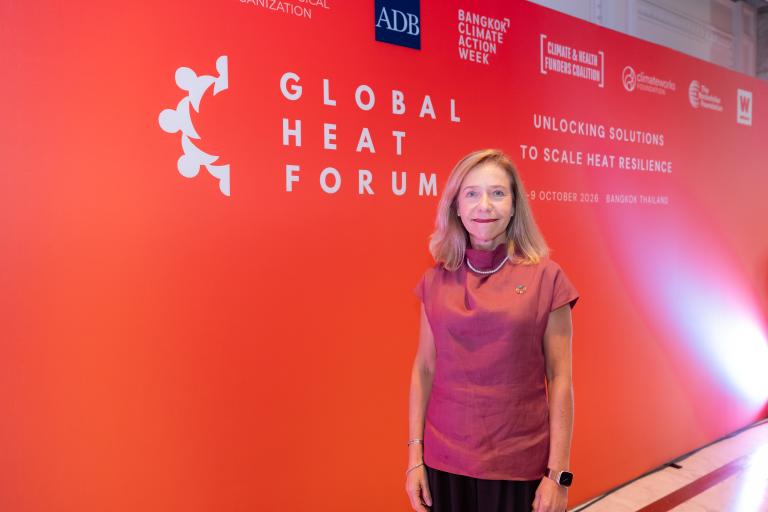
Nearly 600 scientists, business leaders, philanthropists and health experts gathered to propel action to protect livelihoods through tools like strengthened heat governance. Private and public sectors joined the forum to spark solutions from local and global perspectives that help communities and countries adapt in an era of increasing extreme heat.
“Two years ago, I launched a Call to Action on Extreme Heat. Since then, cities around the world have established heat action plans and strengthened worker protections. But developing countries lack support to meet this growing threat. Today, I am calling on every city to build lasting defences against extreme heat. That means every part of government – health, housing, energy and transport – working as one. And it means heat action plans in place by 2030 – backed by the systems and resources to make it real,” said UN Secretary-General António Guterres, addressing the Forum.
This year's heatwaves in Asia, Europe and North America have impacted the economy, fueled deadly wildfires and spiked air pollution. The strengthening El Niño event – coming ahead of the southern hemisphere summer – looks set to lead to more extreme heat.
“At the WMO, we know from experience that El Niño literally turns up the heat. New maximum daytime and minimum overnight temperature records are not just a figure on a thermometer. Our bodies, our infrastructure, our farms and our homes are not designed for the temperatures we are seeing,” said Celeste Saulo, Secretary-General of the WMO. “But prevention begins before the emergency. A forecast must give health services time to prepare, employers time to adjust working hours, and communities time to reach those most at risk.”
The solutions exist. These include early warnings linked to health action plans, climate-smart urban planning for cooler streets and homes, and legislative protection for workers in factories, fields and construction sites. Scaling heat-health warning systems could protect 1.5 billion people and avert nearly 100,000 deaths each year, according to 2025 estimates.
The event opened with the launch of innovative and practical heat action resource tools for governments, cities and health services:
- Extreme heat and health: Global evidence for action, executive summary of a report that details the widest body of evidence yet on how heat harms health.
- The accompanying Burning Questions series answers the most-asked queries on heat action measures, such as potential costs of a heatwave
- What Works Against Heat, a single-stop platform built after a review of 300,000 academic papers and rating over 80 heat interventions, from city planning to building design.
- Global Call to Action on Heat and Women's Health, urging governments to protect women and babies from the health impacts of extreme heat.
- Roadmap for Investment and Action on Extreme Heat, carrying the vital work on extreme heat action forward into COP31 in Antalya.
- First country-level heat and health assessments for Bangladesh, Bhutan, India, and Nepal from the Global Heat Health Information Network’s South Asia Hub.
Quotes from the Global Heat Forum
“Extreme heat is already a health emergency, and an intensifying El Niño will push more people into crisis, overwhelm the clinics that treat them, and erode the safety nets they rely on,” said Dr. Naveen Rao, Senior Vice President of Health at The Rockefeller Foundation. “We cannot afford to wait. We have never been better equipped to anticipate and respond to these shocks, and now it's our responsibility to act quickly to protect those who will be hit first and hardest.”
“Momentum is building among funders, scientists and civil society leaders for stronger climate adaptation, and we are proud to help drive solutions at the Global Heat Forum in Bangkok. As we experience the rapidly accelerating impacts from climate change, particularly during an unprecedented El Niño, adaptation is a critical long-term social and economic investment for communities around the globe,” said Jessica Brown, Senior Director of Adaptation and Resilience at ClimateWorks Foundation.
“Extreme heat fuelled by climate change is impacting our way of life and our health – and yet many countries are not prepared. With El Niño pushing temperatures higher, the failure to act is costing lives. We already know many solutions to protect people – from early warning systems to cooler buildings. But the challenge is providing solutions to those who need them most, including pregnant women and newborns, who face serious risks but often receive inadequate information and support,” said Dr. Madeleine Thomson, Head of Climate Impacts and Adaptation at Wellcome. “We are calling on governments to act through the Global Call to Action on Heat and Women's Health. The tools launched today will help health services and governments to act before the next heatwave to improve health and save lives.”
Quotes from leading researchers
“Extreme heat is already responsible for avoidable illness and death in every region,” said lead author Professor Kristie Ebi at the University of Washington. “The evidence in Extreme heat and health shows where risks are rising, which populations carry the greatest burden, and which interventions have proven benefits. Decision-makers can act on this knowledge starting today.”
“What Works Against Heat is the first open platform to bring global research evidence on heat intervention effectiveness together in one place. Led by the Global Heat Health Information Network and the University of Sydney, this groundbreaking project has examined which measures are the most effective and supported by the best evidence. Each intervention is rated on strength of evidence, effectiveness, cost, time to benefit and environmental impact. Results are sorted by climate, so a planner in a humid coastal city and one in a dry inland region can each find what works for their setting," said Professor Ollie Jay, Director of the Heat and Health Research Centre at the University of Sydney.
Media
Journalists can request further information, accreditation and interviews with Forum experts at media ghhin [dot] org (media[at]ghhin[dot]org)
About the Global Heat Forum
The Global Heat Forum is organized by the Global Heat Health Information Network (GHHIN), the World Meteorological Organization (WMO), the Asian Development Bank, Bangkok Climate Action Week, ClimateWorks Foundation, the Children’s Investment Fund Foundation, the Climate & Health Funders Coalition, The Rockefeller Foundation and Wellcome. It takes place from 6 to 9 October in Bangkok, Thailand, during Bangkok Climate Action Week.
The World Meteorological Organization is the United Nations System’s authoritative voice on Weather, Climate and Water.
For further information, please contact:
- Clare Nullis WMO media officer cnullis@wmo.int +41 79 709 13 97
- Global Communication and Engagement Media Contact media@wmo.int