

Record greenhouse gases trap in more heat for the future
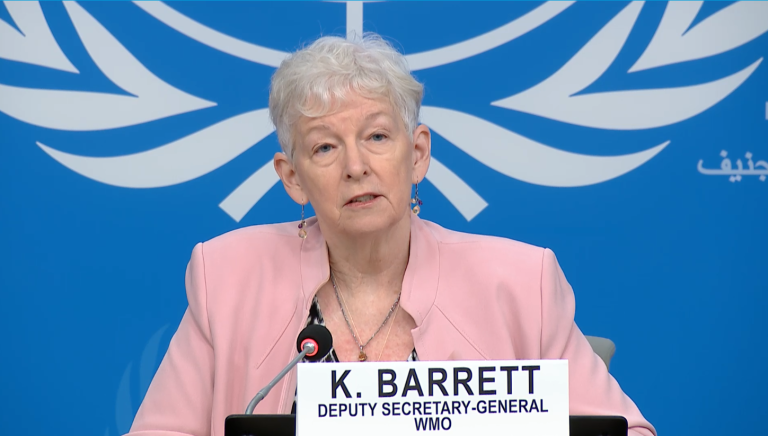
Good morning and thank you for joining our press briefing.
The World Meteorological Organization today releases its annual Greenhouse Gas Bulletin for 2025. And, once again, we are reporting that levels of long-lived greenhouse gases in the atmosphere are at record levels. The big three are carbon dioxide, methane and nitrous oxide.
Since the 1960s, growth rates of CO2 have tripled.
When the Bulletin was first published in 2004, the annual level of carbon dioxide was 377.5 parts per million. In 2025, it was 426.8 parts per million. Data that we have from individual monitoring stations in WMO’s Global Atmosphere Watch show that CO2 levels continue to rise in 2026.
Every additional part per million matters because it traps additional heat. In effect, we are supercharging the ocean and the atmosphere. That means that heatwaves, tropical cyclones, and rainstorms are intensifying faster than our historical baselines prepared us for.
The WMO Bulletin reports on measured greenhouse gas concentrations - the amount of gas that accumulates in the atmosphere - and not new annual emissions. About half of the total CO2 emitted each year remains in the atmosphere and the rest is absorbed by land ecosystems and oceans.
The rate of increase in CO2 between 2024 and 2025 was above the ten-year average, but slightly lower than the exceptional surge we saw between 2023 and 2024.
The more modest growth rate reflects recovery of the land carbon sink in 2025 after the strong 2023/2024 El Nino, which impacted these land carbon sinks through more drought, drier vegetation and more wildfires.
This is important because the exceptionally strong El Niño in 2026 sets the stage for another surge in CO2 levels. The risks of reduced CO2 uptake by a warming ocean are also increasing.
I’d like to move now from carbon dioxide – the most abundant long-lived gas – to gases which are present in much lower concentrations but are of potential concern.
Sulphur hexafluoride is closely related to electricity production and distribution and has been rising over the past three decades because of the switch to global electrification.
Sulphur hexafluoride concentration in 2025 have increased by 249 percent relative to 1995 levels. They are measured in parts per trillion – not million. So why should we be concerned?
Because SF6 has an atmospheric lifetime of up to 3,200 years. Its global warming potential is more than 24,000 times that of CO2.
The energy transition is essential and welcome. But as with every transition, it has to be done in a smart way and informed by environmental observations.
This is why WMO’s Global Atmosphere Watch and the annual Greenhouse Gas Bulletin is so vital because it coordinates and collects these observations which take the pulse of our planet.
I now hand over to senior scientific officer Oksana Tarasova who can present the report to you in more detail.
More information about:
Statement by
