Rising land and ocean temperatures, wilder water cycle, glacier retreat hit Latin America and Caribbean
BRASILIA, Brazil (WMO) - Record-breaking heat, persistent drought, extreme rainfall and devastating tropical cyclones impacted communities and economies throughout Latin America and the Caribbean in 2025, whilst melting glaciers led to an upsurge in short term hazards like floods and long-term water security risk, according to a new report from the World Meteorological Organization (WMO).
- Record-breaking heat poses increased public health burden
- More extreme water cycle means increasing drought or deluge
- Rapidly intensifying hurricanes test preparedness and response
- Glacier retreat threatens long-term water supplies
- Extreme weather and climate hits agro-food systems

Along Atlantic-facing coasts, sea level is rising faster than the global average in parts of the tropical Atlantic and Caribbean. Continuing ocean acidification and warming are compounding risks to marine ecosystems and fisheries, according to the WMO State of the Climate in Latin America and the Caribbean in 2025.
"The signs of a changing climate are unmistakable across Latin America and the Caribbean, from accelerating glacier loss and rising sea levels to rapidly intensifying tropical cyclones, extreme heat, floods and drought,” said WMO Secretary-General Celeste Saulo.
“This report shows that while risks are growing, so too is our capacity to anticipate and act to save lives and protect livelihoods,” she said.
This was exemplified by Hurricane Melissa in October 2025 - the first Category 5 hurricane on record to make landfall in Jamaica. It led to 45 deaths and economic losses of approximately 8.8 billion US dollars, more than 41% of GDP. Even though Melissa had no historical precedent, Jamaican authorities used high-quality risk modelling to inform advance financial measures and disaster preparedness which limited the human toll and helped the island cope.
Another major risk is from extreme heat, which is posing an increasing public health burden. In 2025, recurrent and intense heatwaves – with temperatures well above 40°C - affected large parts of North, Central and South America. There is therefore a pressing need to embed climate intelligence into health planning and emergency preparedness and to integrate meteorological early warnings with public health triggers.
Many countries do not routinely publish cause-specific heat mortality data. It is estimated that there were approximately 13 000 heat-attributable deaths annually (average across 17 countries from 2012–2021). This suggests a significant underestimate of heat related mortality and there is a need for improved reporting, according to the report.
It also examines how agro-food systems are exposed to extreme weather and climate shocks, with simultaneous impacts on agricultural production, rural livelihoods, access to food, and market functioning.
The State of the Climate in Latin America and the Caribbean was launched at Olacyr de Moraes Auditorium at the Ministry of Agriculture and Livestock (MAPA), in Brasília, Brazil. It provides authoritative information on key climate indicators, impacts and risks and on major regional extreme events, including tropical cyclones, heatwaves, heavy rainfall and drought, and cold waves.
“These findings are deeply concerning. But they also show why our work matters. Climate information is not only about data. It is about people,” said Celeste Saulo.
“It is about protecting communities from floods, droughts, hurricanes, heatwaves and other hazards. It is about farmers planning their crops, health authorities preparing for heat-related risks, and coastal communities planning for rising seas,” she said.
“The State of the Climate in Latin America and the Caribbean 2025 is not only a scientific publication. It is a call to action. It calls on us to strengthen observations, invest in services, close early warning gaps, and ensure that climate information reaches those who need it most,” said Celeste Saulo.
Temperatures
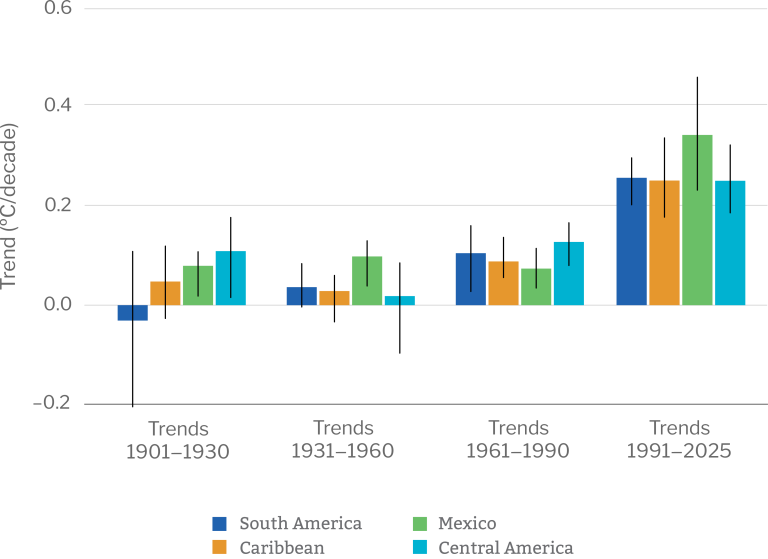
Of the four 30-year periods assessed in the report, the period 1991–2025 shows the strongest warming trend since datasets began in 1900: about 0.26°C per decade across South America, and 0.25 °C per decade across Central America and the Caribbean. Mexico experienced the fastest warming rate, about 0.34 °C per decade from 1991 to 2025.
The average annual mean surface temperature in 2025 ranked between the fifth and eighth warmest on record.
There was record-breaking heat across the region, including 52.7 °C in Mexicali (Mexico) – a new national record – and multiple heatwaves exceeding 40 °C–45 °C throughout Central America. Many places in South America also recorded temperatures above 40°C, with 44 °C in Rio de Janeiro (Brazil) and 44.8°C in Mariscal Estigarribia (Paraguay).
Precipitation
In the last 50 years or so, rainfall in Latin America and the Caribbean has become more extreme – swinging between drought and deluge and with longer dry spells and more intense wet events.
Heavy rainfall events have increased in Central America and in northern South America (for example, in Colombia, the Bolivarian Republic of Venezuela and the Amazon fringe). Southeastern South America (southern Brazil, Uruguay and northern Argentina) has also seen an increase in annual rainfall, and more frequent floods.
Central Chile, north east Brazil and some areas of Central America and the Caribbean are becoming drier. The Amazon region is a mixed picture, with longer dry seasons, stronger wet-season extremes and increased drought frequency in the southern and eastern Amazon.
In 2025, extreme rainfall and flooding triggered major humanitarian impacts, including over 110 000 people affected in Peru and Ecuador (March floods), 83 deaths in Mexico (October floods) and widespread landslides and infrastructure damage.
June 2025 was the rainiest month ever recorded in Mexico. Despite this, drought gripped northern and central regions of Mexico – covering up to 85% of the country at its peak and creating a water crisis for crops and reservoirs. There were severe water shortages in the Caribbean and over 40% rainfall deficits in parts of southern South America, contributing to agricultural losses and wildfire risk.
Glacier retreat
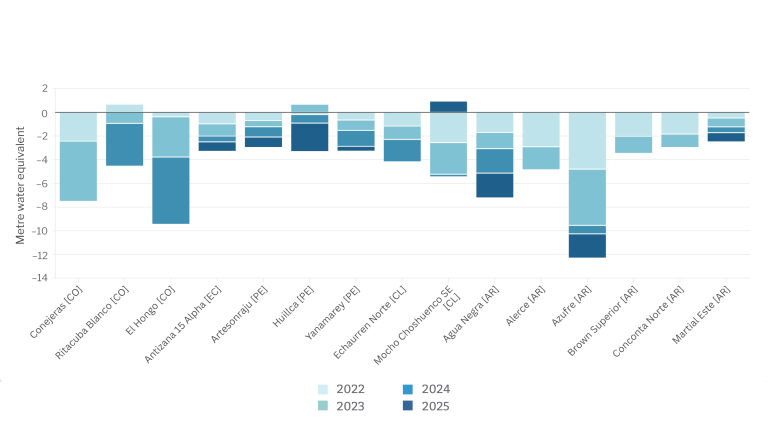
Andean glaciers form a critical water tower for approximately 90 million people, supplying freshwater for domestic consumption, hydroelectric power, agriculture and industry.
Recent global glacier mass balance datasets show accelerating losses in the high-mountain southern Andes, as well as tropical glaciers in low-latitude regions like Colombia and Ecuador.
The convergence of accelerating ice loss, rising water demand and limited adaptive capacity – particularly among rural Andean communities – makes the future of the Andean water tower one of the most pressing water security challenges in Latin America.
Ocean
Latin America accounts for 8.8% of the world’s coastline. The ocean is absorbing excess heat and carbon dioxide from human activities. The resulting ocean acidification and warming combined with deoxygenation are affecting marine ecosystems and coral reefs, harming fisheries and local economies.
In 2025, surface ocean pH continued to decline (acidification), reaching a record low in large parts of the Atlantic and Pacific adjacent to the region.
Extreme marine heatwaves occurred in the Gulf of Mexico and the Caribbean Sea, and in the ocean area adjacent to Chile.
Along Atlantic-facing coasts, rates of sea level rise are exceeding the global average in parts of the tropical Atlantic and Caribbean.
Notes to Editors
The State of the Climate in Latin America and the Caribbean was produced by WMO in collaboration with National Meteorological and Hydrological Services, international data centres, leading climate research institutions and United Nations partners, including the Pan-American Health Organization, Food and Agriculture Organization and UN Office for Disaster Risk Reduction.
Dozens of experts and institutions contributed to this report. WMO is especially grateful to lead author José A. Marengo of Brazil’s National Centre for Monitoring and Early Warning of Natural Disasters (CEMADEN).
The World Meteorological Organization is the United Nations System’s authoritative voice on Weather, Climate and Water.
For further information, please contact:
- Clare Nullis WMO media officer cnullis@wmo.int +41 79 709 13 97
- Global Communication and Engagement Media Contact media@wmo.int