Ocean Heat Reveals Earth's Energy Imbalance
- Author(s):
- Benoît Meyssignac (Université de Toulouse, LEGOS (CNES/CNRS/IRD/UT3)), Maria Hakuba (NASA JPL), James Reagan (NOAA NCEI), Patrick Taylor (NASA LaRC), Tristan L’Ecuyer (University of Wisconsin-Madison), Hirohiko Masunaga (Nagoya University), members of the GEWEX/GDAP Earth Energy Imbalance Assessment Team

At its heart, climate change is not primarily a story about temperature. It is a story about energy. At the start of the industrial era, in the early 18th century, Earth’s climate system was close to a steady state: the energy arriving from the Sun and the energy leaving the planet were, on average, in balance.
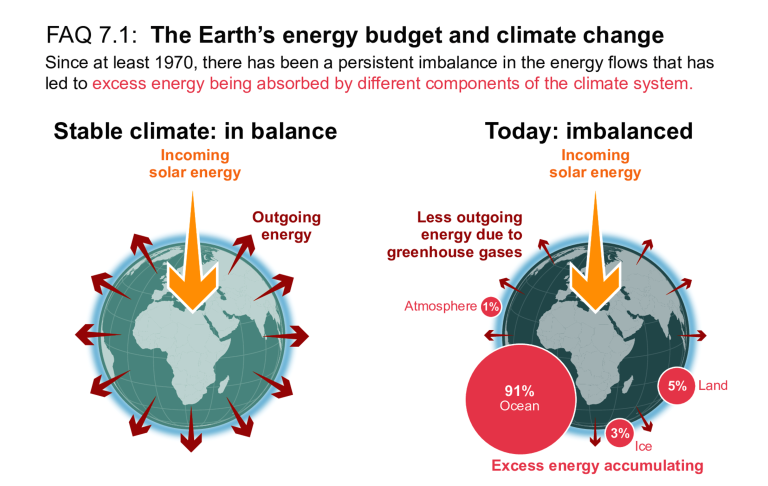
Earth continuously receives energy from the Sun at the top of the atmosphere – roughly 340 watts per square metre averaged over the entire planet – mostly in the form of shortwave radiation. In a balanced climate, Earth returns an equivalent amount of energy to space. Some of this energy leaves as reflected sunlight, bounced back by clouds, ice, snow and the Earth’s surface; the remainder leaves as longwave, or thermal, radiation emitted by the surface and atmosphere (Fig 1, left panel).
Over the past 150 years, however, human activities have disturbed this balance. Emissions of greenhouse gases and aerosols, together with changes in land use and land cover, have altered the amount of energy Earth emits and reflects back to space. Greenhouse gases act as a partial lid on the planet’s thermal radiation, reducing the amount of heat escaping to space, while incoming sunlight remains essentially unchanged. The result is a small but persistent surplus: Earth is now absorbing more energy than it releases (Fig 1, right panel).
This imbalance triggers a cascade of feedbacks that amplify its effects. As the atmosphere and surface warm, more water vapour enters the atmosphere, where it acts as a greenhouse gas. The vertical temperature structure changes, reflective ice and snow retreat, and cloud patterns shift – each of these processes further modifies the radiation balance, generally reinforcing the initial imbalance.
The resulting net imbalance, known as Earth’s energy imbalance (EEI), is measured at the top of the atmosphere and currently stands at roughly 0.9 watts per square metre, averaged over the past two decades. This means each square metre of Earth is gaining almost one additional watt of energy compared with the amount it loses to space, continuously, day and night.
The EEI is not constant. It fluctuates around its positive average as a result of natural climate variability, such as the El Niño-Southern Oscillation, volcanic eruptions, solar variability and other smaller factors that influence Earth's energy balance. However, its underlying positive long-term average is driven predominantly by rising greenhouse gas concentrations. If greenhouse gas concentrations were to stabilize, the EEI would gradually decline towards zero as the climate system approached a new steady state.
This is precisely why the EEI matters. It provides a direct measure of how far the climate system is from a steady state and is arguably the single most fundamental metric for assessing the status of climate change.
Unfortunately, observations do not show a declining EEI – quite the opposite. Satellite and in-situ observations point to a significant increase since 2004, driven largely by a decline in Earth’s reflectivity. This decline is linked to changes in clouds, surface albedo and atmospheric aerosols, themselves influenced by human activities and climate feedbacks. A rising EEI indicates that heat is accumulating in Earth's climate system at an increasing rate (or, in other words, that global warming is accelerating).
The consequences of a positive EEI extend well beyond a rising thermometer. The imbalance drives global temperature rise, but it also drives ice melt and ocean warming, contributes to sea-level rise through thermal expansion and accelerated melting of glaciers and ice sheets, intensifies the hydrological cycle, and is linked to more frequent and severe climate extremes, including marine heatwaves.
The EEI is therefore not only a fundamental measure of the state of the climate system; it is also the fundamental driver of the rate at which anthropogenic global warming unfolds. Quantifying it accurately is thus critical to understanding both the magnitude and the pace of ongoing climate change.
The ocean: Earth’s heat reservoir
A positive EEI means that more energy is entering the climate system than is leaving it. The climate system as a whole is therefore accumulating energy (Fig 1, right panel). This accumulation of heat is what we call global warming.
Where does all this additional energy go? Overwhelmingly, into the ocean. More than 90% of the excess energy associated with a positive EEI ends up stored as additional ocean heat content (OHC). A much smaller share – a few percent – goes into melting Arctic sea ice, glaciers, and the Greenland and Antarctic ice sheets. The remainder warms the land surface and atmosphere, while changes in the kinetic and chemical forms of energy within the climate system make only a negligible contribution.
This dominance of the ocean is explained by its enormous heat capacity. Water can absorb far more heat than air or rock for the same increase in temperature. The atmosphere and land surface cannot store comparable amounts of heat. Over periods ranging from a year to several decades, their combined heat capacity is roughly equivalent to just the upper 2.5 metres of the ocean – less than 1% of its average depth. Much of the 3%–4% of excess heat that is absorbed by the cryosphere goes into melting the ice (latent heat) rather than raising its temperature (sensible heat).
The ocean therefore acts as the planet’s principal heat reservoir. Most of the multidecadal warming has occurred in the upper 700 metres of the global ocean, where the signal is strongest and observations are historically most extensive. But the deep ocean is far from unaffected. As much as one quarter of the increase in OHC since the 1970s is estimated to have occurred below 700 metres, a finding supported by ocean reanalyses.
Because the ocean stores the overwhelming majority of the excess heat, changes in global OHC provide a strong constraint on the EEI itself, from year-to-year variations to long-term trends. The contributions from the atmosphere, land and ice are comparatively small. Therefore, tracking how much heat the ocean is gaining is one of the most powerful ways scientists can monitor global climate change.
Measuring the ocean’s heat: how scientists quantify EEI
Given its central importance, how is the EEI actually measured?
The most direct approach relies on satellites that observe incoming and reflected solar radiation, together with outgoing thermal radiation, across broad spectral bands. This is technically challenging because the EEI is a small difference between two enormous flows of energy, each roughly two orders of magnitude larger than the imbalance itself. Extracting a signal of a few tenths of a watt per square metre from measurements that are around a hundred times larger requires an exceptionally high level of absolute calibration accuracy. Current instruments cannot fully achieve this. As a result, the absolute magnitude of the EEI cannot be reliably determined from satellite radiation measurements alone.
Where satellites excel, however, is in tracking how the EEI changes over time. Because many sources of measurement error are systematic and therefore relatively stable, satellite records detect changes and long-term trends in the EEI with an estimated uncertainty of around 0.2 watts per square metre. This is relatively small compared with the current imbalance of approximately 0.9 watts per square metre, even though satellites cannot determine its absolute value with sufficient accuracy.
A complementary and powerful approach is to estimate the EEI indirectly by measuring the rate at which energy is being stored within the climate system. Since the contributions from melting ice and warming of the land and atmosphere are comparatively small, this indirect approach critically depends on accurately estimating changes in ocean heat content.
Ocean heat content is estimated from measurements of ocean temperature at different depths, compared with a long-term reference average, ideally over the full depth of the ocean. However, observational limitations have historically confined measurements to shallower depths.
Before 2000, ocean temperature measurements were concentrated mainly in the upper 700 metres. This limitation stemmed primarily from the widespread use of expendable bathythermographs (XBTs), instruments deployed from ships to measure temperature at different depths. They were also unevenly distributed around the globe and affected by changes in instrumentation over time. These limitations introduced biases and substantial uncertainty into early estimates of OHC.
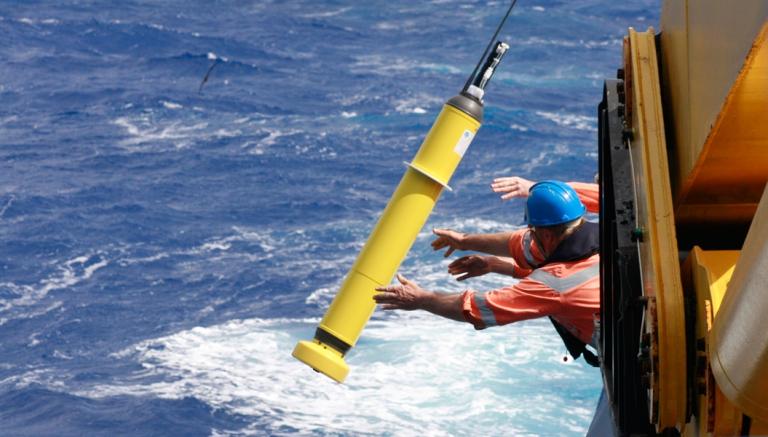
This situation changed dramatically with the deployment of the international Argo array: a fleet of autonomous profiling floats equipped with high-precision sensors that drift throughout the world’s oceans and periodically surface to transmit their observations by satellite (Fig 2).
For the first time, Argo enabled continuous, quality-controlled monitoring of temperature and salinity throughout the upper 2 000 metres of the near-global ocean. By around 2005, the array had achieved sufficient coverage to substantially improve estimates of OHC, reducing uncertainty in estimates of the energy imbalance to roughly 0.3 watts per square metre over periods of a decade.
However, the ocean observing system remains incomplete. The deep ocean below 2 000 metres, which accounts for nearly half of the ocean’s volume, is sampled only sparsely, mainly through research vessels conducting detailed measurements along selected routes and, more recently, through the Deep Argo, a growing network of specialized floats capable of measuring temperatures at depths of up to approximately 6 000 metres. Coverage also remains limited in marginal seas, beneath sea ice and at latitudes beyond 60° north and south.
Differences in statistical mapping and quality control methods introduce further discrepancies between OHC estimates from a variety of research groups. The International Quality-controlled Ocean Database (IQuOD) project is working to address some of these challenges and improve the consistency and quality of ocean observations.
A further, independent approach to estimating OHC combines satellite measurements of global mean sea level with measurements of changes in the ocean's mass, obtained by satellites that detect variations in Earth's gravity. The difference between these two quantities allows scientists to estimate how much sea level has risen because seawater has expanded as it warmswhich is directly related to changes in ocean heat content.
Because this satellite-based “geodetic” approach captures the full depth of the ocean, it provides full-depth OHC estimates that are independent of in-situ profiling. Recent estimates suggest an uncertainty of around 0.45 watts per square metre for changes in global, full-depth OHC between 2005 and 2023. These estimates agree, within uncertainty, with ocean-profile observations.
Because the geodetic approach is based on data with almost global coverage, it can also capture year-to-year variability in OHC. Reassuringly, these independent estimates agree, within uncertainty, with estimates derived from satellite measurements of radiation at the top of the atmosphere.
More recently, hybrid methods have emerged that combine in-situ and geodetic ocean observations. These methods draw on the full-depth coverage of geodetic techniques while retaining the vertical resolution provided by in-situ instruments such as Argo.
Today, these hybrid approaches, together with ocean reanalyses, which combine observations with numerical models to reconstruct past ocean conditions, provide some of the closest agreement with satellite-based radiation measurements, with uncertainties as low as around 0.2 watts per square metre.
Crucially, OHC-based approaches remain the only means currently available for estimating the absolute magnitude of the EEI.
Safeguarding our capacity to track climate change
Observations of ocean heat are indispensable, both for measuring the absolute magnitude of the EEI and for understanding the physical mechanisms linking changes in the EEI to changes in global surface temperature.
This makes continued, sustained and internationally coordinated investment in ocean observing systems essential. Argo, together with complementary in-situ networks, forms the critical backbone of the ocean heat observing system. When combined with sustained satellite altimetry and gravimetry missions, these observations enable increasingly accurate and precise estimates of OHC. Looking ahead, the deep ocean is projected to absorb an increasing share of excess heat in the coming decades, making the continued global expansion of Deep Argo particularly important. At the same time, the future of satellite-based radiation observations faces its own uncertainties. Beyond the National Aeronautics and Space Administration (NASA)’s Libera mission, with a projected end of life around 2032, no space agency has yet announced firm plans to continue broadband Earth radiation budget observations.
Maintaining a continuous satellite record is critical. The accuracy of the satellite radiation record depends on carefully overlapping successive missions, and any gap could compromise the integrity of the entire multi-decadal record. This makes sustained observations of ocean heat content even more important. OHC provides an independent means of tracking the EEI and the pace of climate change, even if satellite radiation observations are interrupted.
The overarching conclusion emerging from the international scientific community is clear: ensuring continuity of both Earth radiation budget and ocean heat observations will require more than simply maintaining current instruments and missions. Future observing systems must simultaneously preserve long-term climate records, address emerging scientific questions, including those raised by the unexpected increase in EEI, and adapt to evolving technological and budgetary realities.
The ocean has absorbed the overwhelming majority of the excess heat generated by human activities over the past century and a half, acting as a buffer that has spared the atmosphere and land surface from even more rapid warming. Continuing to measure excess ocean heat accurately, comprehensively and without interruption is fundamental to understanding how the climate system is changing and anticipating what may come in the future.