INFCOM closing statement: We are collectively responsible for a global public good
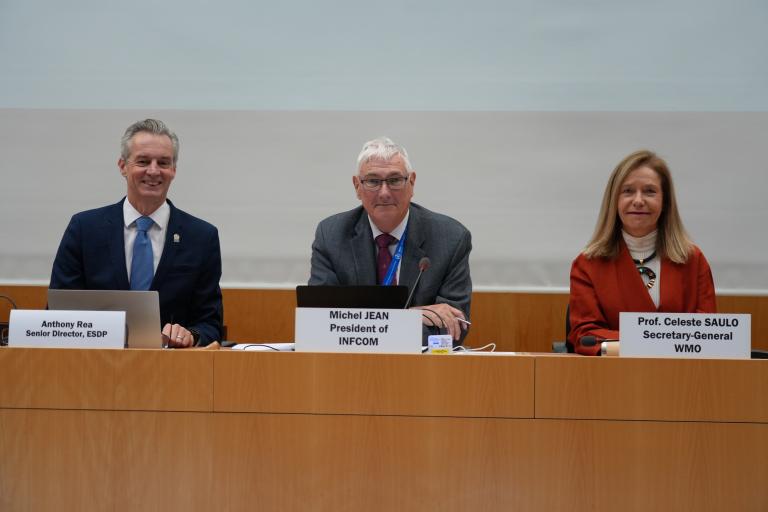
President of INFCOM, Co-Vice-Presidents, Members, colleagues and friends,
On Monday, I told you that you are WMO’s backbone. After this week, I say it again, with even more conviction.
This was not an easy week. Some discussions ran late into the evening, and some positions remained far apart. But you stayed at the table, listened to each other and made a genuine effort to find common ground.
Let us put things into perspective. Out of 47 decisions, resolutions and recommendations, only four had to be referred to the Executive Council because consensus could not be reached on wording that was not purely technical. Similar differences remain on three recommendations to Congress.
Several of you have told me that, despite these difficulties, you feel we have made significant progress. I share that assessment.
You have advanced the WIGOS (WMO Integrated Global Observing System) Vision 2050, strengthened our measurement and data standards, and set out a path to bring water and ice into GBON (Global Basic Observing Network). With the Global Cryosphere Watch Implementation Plan and the Flood Forecasting Framework, we are better positioned to address critical gaps in our ability to protect people.
You have secured a way forward for OSCAR/Surface (Observing Systems Capability Analysis and Review Tool). I particularly welcome yesterday’s unanimous decision by the EUMETNET General Assembly to establish a new OSCAR/Surface Mandatory Programme, and I thank all Members and partners who have contributed to this effort. A special thanks to the Swiss Government and MeteoSwiss also for the support they have been providing.
WIS (WMO Information System) 2.0 continues to gain ground. And I look forward to seeing the first equipment compliant with the first-mile standard at INFCOM-5. The new WIPPS (WMO Integrated Processing and Prediction System) Strategy and the designation of twenty new centres further strengthen our global prediction capabilities.
These are substantial achievements. They demonstrate that WMO continues to set the direction for technological development and its operational application worldwide.
Colleagues,
This week has illustrated the delicate balance between diplomacy and technical cooperation. Both are essential to an intergovernmental organization. But as scientists and technical experts, we know that our work must ultimately be judged by its results.
The infrastructure you govern represents an investment of around US$ 10 billion every year. No country could build it alone, and no country could run it alone.
We are collectively responsible for a global public good that has a direct impact on the quality of life of every person on this planet. That responsibility must remain at the centre of our discussions, even when our positions differ.
WMO’s relevance cannot be taken for granted. We earn it through the decisions we make, the technological progress we enable and the benefits our work brings to society.
So, as you return home, I ask you to focus on three priorities.
First, implementation. A standard only protects lives once it is implemented in your networks, your centres and your services.
Second, engage with your national spectrum regulators now, while positions for WRC-27 are still taking shape. Show them how much our ability to protect lives and livelihoods depends on access to the radio-frequency spectrum.
Third, prepare for Congress. Some of the differences we could not resolve this week will require further discussion and decisions at the highest level of our Organization.
We must use the months ahead to understand each other’s positions and explore ways forward. Respecting national positions is fundamental, but so is recognizing our collective responsibility. We cannot allow our differences to overshadow the purpose for which this Organization exists.
I thank every Member, every expert, the Secretariat and our interpreters for their commitment and patience throughout this demanding week.
And before I close, one more thing.
Many of you have asked me, this week and over recent months, whether I would be willing to serve a second term. I have been genuinely touched by your support and encouragement.
My answer is yes. I would be honoured to continue serving as Secretary-General of WMO, should Members so decide.
The work we have begun together is not yet finished. We have laid important foundations, but there is still much to do to make this Organization stronger and more responsive to the needs of every Member.
Thank you for your trust, your commitment to WMO, and safe travels home.
Statement by