Funding
How is WMO funded?
WMO has two primary funding solutions
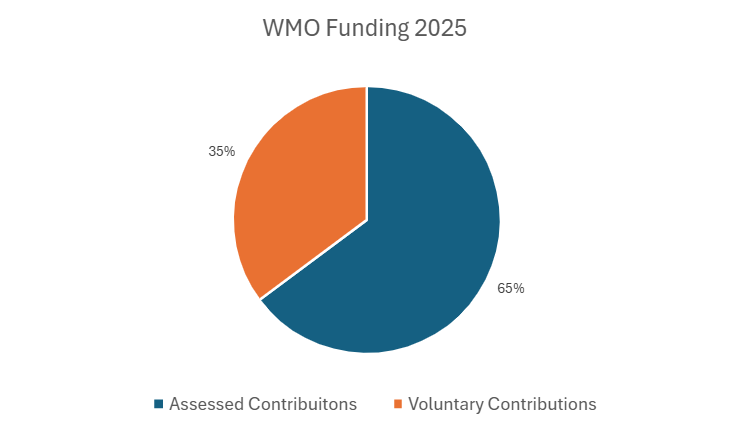
- Assessed contributions by Members, which are annual amounts due from each Member determined as a percentage of the approved Regular Budget
- Voluntary contributions, which are provided for thematic priorities or in support of specific programmes and projects. Voluntary contributions are received from a diverse group of funding partners, including governmental donors, international organizations (including International Financial Institutions (IFIs) and UN system organizations), climate funds, and private sector entities and foundations.
The funding of WMO in 2025 can be seen in the following chart:
Assessed contributions
Members fund the Organization through assessed contributions, which are annual amounts due from each Member determined as a percentage of the approved Regular Budget. The determination of the percentage due from each Member, the scale of assessment, is approved by the World Meteorological Congress and is based upon the UN scale of assessment, adjusted for differences in membership between WMO and the UN and to take into consideration the minimum rate of assessment at WMO of 0.02%.
To determine the actual amount due by each Member for the annual assessment, the approved scale of assessment is applied to the approved Regular Budget. The Regular Budget is denominated in Swiss francs, the primary operating currency of the Organization, and approved by the Executive Council on a biennial (two consecutive calendar year) basis.
The assessment for each Member for a given biennium is due and payable as one-half of the total on 1 January of each of the two calendar years comprising the biennium.
The Table for Assessed Contributions - 2023-2026 shows the scale of assessment and the assessment amount for each Member for the preceding four years. The approved Regular Budget for the current and preceding biennium can be found here:
- Biennial Budget 2026-2027: Arabic, Chinese, English, French, Russian, Spanish
- Biennial Budget 2024-2025: Arabic, Chinese, English, French, Russian, Spanish
Voluntary contributions
Thematic funding: WMO Commons
The WMO Commons is a financing and engagement mechanism for sustaining, strengthening and modernizing the global weather, climate and water intelligence system.
Every forecast, early warning, climate-risk assessment and weather-sensitive investment depends on a shared global backbone. This includes observations, data exchange, forecasting and prediction systems, standards, regional centres and National Meteorological and Hydrological Services (NMHSs). No country can sustain this system alone, yet all countries and many sectors depend on it.
The WMO Commons enables governments, philanthropic organizations, the private sector and other partners to invest collectively in this global public good. Contributions to the Commons are pooled and unearmarked, allowing WMO to allocate resources strategically across agreed priorities and emerging needs in line with established governance, financial and oversight arrangements.
Further information is available on the WMO Commons website
Project funding
WMO works with bilateral donors, climate funds, multilateral development banks, UN partners, philanthropies and the private sector to support the design and implementation of projects that strengthen National Meteorological and Hydrological Services (NMHS). These investments help countries improve weather, climate and water services, protect lives and livelihoods from natural hazards, and support sustainable development. WMO brings operational technical expertise and proven capacity for project management and implementation, ensuring that every investment delivers measurable, sustainable and quality results.
When governments receive funding from donors or development partners, WMO provides authoritative technical advice in support of strategic and effective investment decisions tailored to national contexts. This advisory role ensures that national priorities are translated into well-designed, technically sound investments that address country-specific needs and align with internationally agreed standards.
WMO works alongside development partners and donors to integrate weather, water and climate expertise into broader development and climate programmes. Through technical reviews, co-design of interventions, secondment of expertise, and capacity support, WMO helps embed these considerations in investments that advance resilience, adaptation, and sustainable development.
Other programmatic funding
WMO also receives funding through its Voluntary Cooperation Programme (VCP), which connects countries across the WMO community to share expertise, resources and solutions. Other forms of voluntary contributions include single country trust funds that facilitate programmatic support aligned with WMO and country shared priorities, and staffing support in the form of expert secondments and junior professional officers (JPOs).