
Beyond the Cone: Using Probabilities to Improve Tropical Cyclone Preparedness
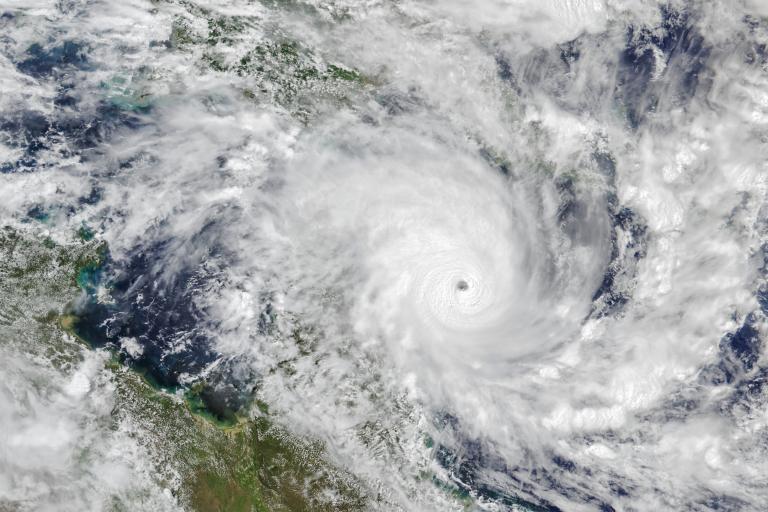
When Typhoon Haiyan struck the Philippines in 2013, killing more than 6 000 people, it exposed a painful gap between forecast information and local decision-making. Forecasts could indicate the storm’s likely path and intensity but translating that information into clear guidance for coastal communities remained a challenge.
More than a decade later, the Philippine Atmospheric, Geophysical and Astronomical Services Administration (PAGASA), the country’s national meteorological service, is continues to transition towards probabilistic storm surge forecasts that show not one outcome but a range of possible scenarios. Combined with impact matrices, they help local governments understand which areas are most likely to flood and when. Yet, as a recent WMO workshop on tropical cyclone probabilistic forecasting highlighted, most forecast centres have yet to implement these approaches.
The products exist but aren’t reaching people
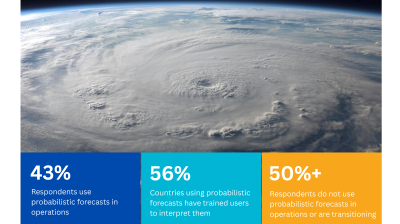
Preliminary results of a WMO survey of 78 countries, presented at the workshop, found that only 43% of respondents currently use probabilistic forecasts operationally, while more than half either do not use them at all, or are still transitioning. The barrier is rarely technology alone. It is training, communication, and the difficult task of making uncertainty useful.
Across tropical cyclone forecast centres, probabilistic products have become increasingly sophisticated. Dynamic cones, based on ensemble forecasts, can reflect the uncertainty around a particular storm rather than historical averages. Strike probability maps, wind speed probability products, and storm surge tools can help forecasters and emergency managers understand not only where a storm might go, but also the impacts it could produce.
However, these tools often stop short of the people who need them most. Only 56% of countries already using probabilistic forecasts have trained their users to interpret them, and fewer than half incorporate uncertainty information in public warnings. The priority is clear: more training, better communication, and products designed around real-world decisions.
From data to decisions
Probabilistic information can support action when matched to specific decisions. In western Australia, offshore oil and gas operators use probabilistic wind and sea-state guidance to decide when to de-staff platforms, disconnect from wellheads, or move vessels to safety. For them, a low-probability but high-impact scenario can justify a multi-million-dollar safety decision.
Emergency services can use the same information differently, focusing on one critical question: when could destructive winds first reach a community? Probabilistic forecasts are most valuable when they are designed to support specific decisions being made, rather than simply provide data.
AI raises the stakes
AI-based weather models, together with AI-assisted post-processing, are creating new possibilities. The Hong Kong Observatory reduced tropical cyclone track forecast errors by more than 30% at four- and five-day lead times after introducing AI weather prediction models into operational forecasting. Large AI ensembles are also being evaluated for use in probabilistic forecasting of cyclone tracks, formation, rapid intensification, and storm surge.
But more information does not automatically lead to better decisions. Thousand-member ensembles can produce more uncertainty information than any forecaster can easily process, and the “black box” nature of AI can make forecast changes harder to explain.
For smaller national meteorological services, rapid technological progress risks widening existing capacity gaps. At the same time, AI makes human expertise more important, not less. Forecasters still need to evaluate model output, translate uncertainty into actionable guidance and communicate clearly with disaster managers.
The work ahead
The workshop, organized by the World Weather Research Programme's (WWRP) Working Group on Tropical Meteorology Research (WGTMR), in conjunction with the Working Group on Predictability, Dynamics and Ensemble Forecasting (PDEF), attracted nearly 700 participants from more than 80 countries, two thirds of them early career professionals. They called for more hands-on training, multilingual e-learning, and peer-to-peer mentoring between services facing similar hazards.
The science behind probabilistic tropical cyclone forecasting has never been stronger. The challenge now is to ensure it reaches the forecasters, emergency managers, and communities who need them before the next storm arrives.