Scientists Unite to Better Understand North Pacific Ocean Extremes
- Author(s):
- Karen L. Hunter (DFO), Antonietta Capotondi (CIRES, NOAA), Helen Killeen (CDFW), Shoshiro Minobe (Hokkaido University), Steven J. Bograd (NOAA), Charles G. Hannah (DFO), Hiroki Wakamatsu (PRIMAFF), Chan Joo Jang (KIOST), Sonia D. Batten (PICES), Robert Suryan (NOAA)

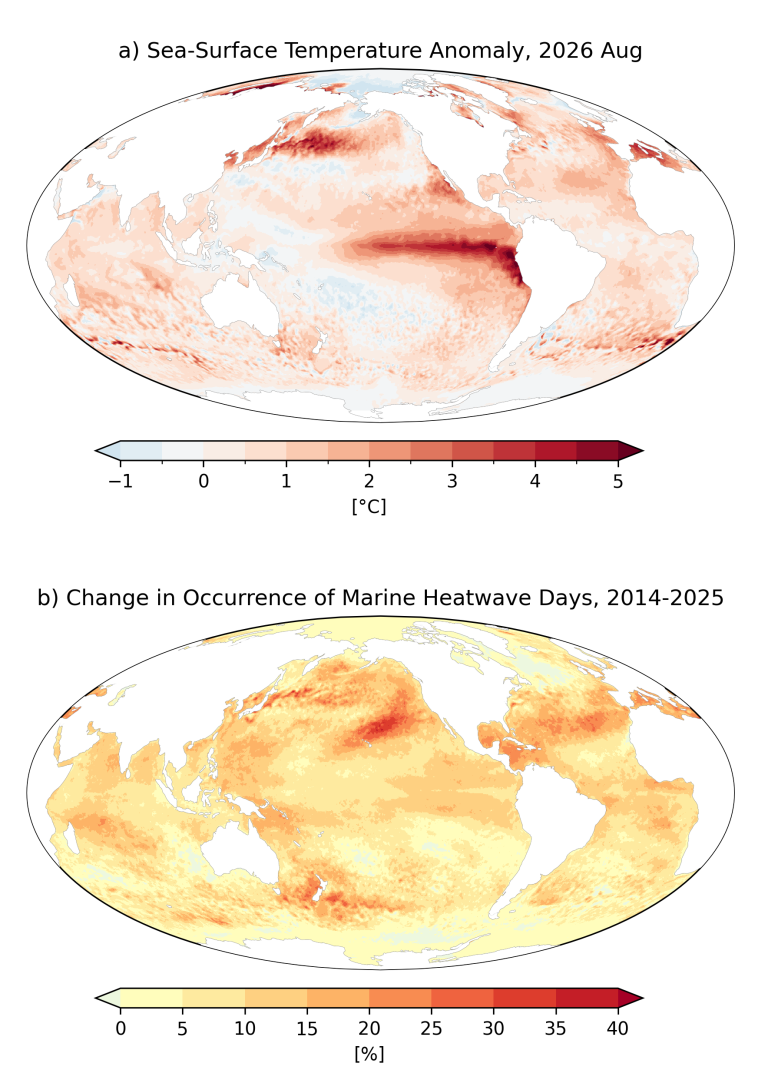
Global temperatures have reached record highs during 2026 with much of the global ocean experiencing unusually warm conditions in August. The North Pacific stands out as a warming hotspot, with sea-surface temperatures anomalies reaching 2.5 °C across extended areas (Figure 1a).
The extreme conditions in 2026 align with the apparent acceleration in the frequency and intensity of extreme sea-surface temperatures recorded since 2023, when globally averaged sea-surface temperatures showed a marked increase relative to previous years. This warming is not limited to the surface but is also associated with an increase in upper-ocean heat content, particularly in the North Pacific.
Recent estimates showed that the North Pacific – a basin bound by the equator, Bering Strait, East Asia and North America – which accounts for only about 18% of the global ocean surface area, contributed almost 30% of the increase in global ocean heat content in the upper 700 metres in recent years, compared with the first decade of the 21st century. This disproportionate contribution highlights the region’s importance in global oceanic heat uptake.
Warming across the North Pacific has also been persistent. In the northwest part of the basin, extreme warming started around 2018 as the result of basin-wide changes in atmospheric and oceanic circulations. This extensive warming has deeply affected coastal regions and local communities. Large-scale changes in wind patterns have altered the path of the Kuroshio current and its eastward offshore extension, leading to persistent marine heatwaves near the east coast of Japan. These conditions have affected cyclone and typhoon patterns, fish distribution and local atmospheric processes, including heatwaves and extreme precipitation over the adjacent land.
Although the North Pacific has experienced record heat over broad areas in recent years, exceptional marine heatwaves have also occurred in the past. One example is the 2013 – 2016 northeast Pacific marine heatwave (Bond et al. 2015) which developed in the Gulf of Alaska during the winter of 2013 – 2014 with unprecedented intensity at the time and subsequently extended towards the North American coast. As the 2015 – 2016 El Niño developed in the equatorial Pacific, the warming spread southward along the coast, resulting in one of the most extreme, extensive and long-lasting events on record. Marine heatwaves were also recorded in small bays and fjords along the west coast of North America, from British Columbia to Southern California (e.g. Jackson et al. 2018).
Marine heatwave occurrence across the North Pacific was markedly higher during 2014 – 2025 than during 2002 – 2013 (Figure 1b), reinforcing evidence of increasing marine heatwave activity across the basin. These events often coincided with other environmental stressors, including ocean acidification, low chlorophyll and low-oxygen conditions. The 2013 – 2016 northeast Pacific marine heatwave, for example, was identified as a compound event, involving these three stressors alongside high temperatures during different stages of its development.
The far-reaching impacts of ocean extremes
Extreme climate events have had widespread consequences for marine ecosystems and the communities that depend on them, as documented in a recent study. In the North Pacific, marine heatwaves have damaged temperature-sensitive coral reefs and water quality-sensitive kelp, seagrass and mangrove ecosystems, while favouring certain algal species associated with harmful algal blooms. They have also contributed to declining fish stocks, shifts in species distributions towards warmer-water communities, mass mortality events among seabirds and large marine animals, and the loss of habitat and ecosystem services.
The consequences extend throughout marine food chains. In the northeast Pacific, two major marine heatwaves led to the collapse of Gulf of Alaska Pacific cod stocks in 2015 and Bering Sea snow crab populations in 2019, with starvation identified as the major factor. Offshore, these events altered plankton communities and reduced the downward transport of carbon, with effects throughout the marine food chain. Such changes can cause significant economic losses for fisheries and aquaculture. In South Korea, coastal marine heatwaves have increased risks to aquaculture, prompting the government to introduce an early warning system and an insurance programme.
Beyond their ecological and economic effects, marine heatwaves can also affect human physical and mental health as well as coastal communities' cultural heritage and traditional ways of life.
A coordinated response to ocean extremes
The Pacific Ocean is influenced by large-scale patterns of climate variability, including the El Niño-Southern Oscillation, the Pacific Decadal Oscillation and the North Pacific Gyre Oscillation, which can influence the development of marine heatwaves and other extremes across the whole basin. These events affect countries throughout the North Pacific, creating shared challenges that require regional scientific cooperation.
The North Pacific Marine Science Organization (PICES) coordinates marine research and promotes scientific cooperation among member countries: Canada, China, Japan, the Republic of Korea, the Russian Federation and the United States of America. Its work covers ocean environment, global weather and climate change, marine living resources and their ecosystems, and the interactions between human activities and the marine environment.
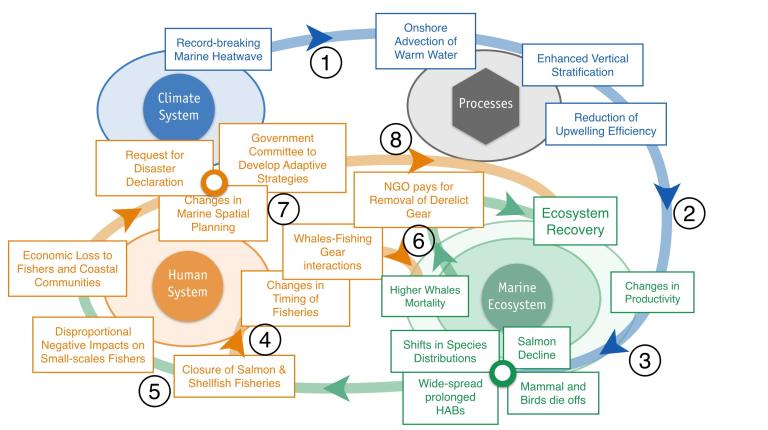
To connect research across disciplines, PICES has adopted a Social-Ecological-Environmental Systems (SEES) framework to facilitate the exchange of information within the organization, allowing for a common transdisciplinary language and integration of knowledge across diverse expertise. The SEES approach was applied to a case study of the northeast 2013 – 2016 Pacific marine heatwave, enabling researchers from different disciplines and expert groups to examine its causes, ecological and societal impacts, and potential responses (Figure 2).
The study traced how unusually warm waters contributed to harmful algal blooms, declines in salmon populations and changes in species distribution. These disruptions led to fishery closures and economic losses for coastal communities. Changes in fish distribution also brought more anchovies into nearshore waters, attracting feeding whales that became entangled in fishing gear, particularly following delays to the crab fishing season.
The framework also captured the responses to these impacts, including adaptive fisheries management measures developed at the request of fishers and funding from a non-governmental organization to remove abandoned fishing gear.
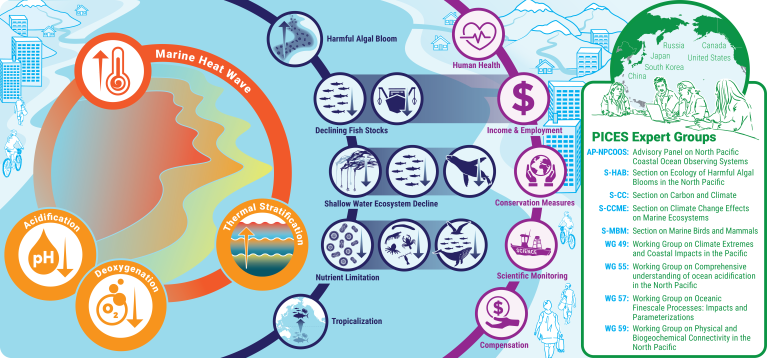
Building on this approach, PICES and the Climate and Ocean: Variability, Predictability and Change (CLIVAR) established Working Group 49 (WG-49) on Climate Extremes and Coastal Impacts in the Pacific. The group aims to improve understanding of the causes and impacts of climate extremes, assess their predictability, and explore potential solutions to mitigate their societal impacts (Figure 3).
Addressing gaps in ocean extremes research
Over the past four years, WG-49 has brought together researchers from across the North Pacific to conduct a systematic review of marine heatwaves, cold spells, and acidification and low-oxygen events. The review screened 2 796 peer-reviewed studies and selected 335 for full review. Using the SEES framework, researchers examined the causes and impacts of extreme events across the region, identifying both established findings and gaps in scientific knowledge.
The review revealed the prevalence of ecological and socioeconomic impacts of marine heatwaves, including changes in phytoplankton and forage species, stress to top predators and economic losses associated with fishery closures. It also identified conservation measures and ecosystem monitoring as common management responses. While research on marine heatwaves has grown considerably, comparatively few studies have examined the causes and impacts of individual low-oxygen and acidification events. These biogeochemical events and their co-occurrence with marine heatwaves may produce some of the most pronounced socioecological impacts in the coming decades.
Extreme conditions occur not only at the surface but also below it, where they can be very detrimental to marine life. Satellite observations provide extensive coverage of sea-surface temperature, but studying subsurface extremes is more difficult because long-term temperature records below the surface are sparse.
To address this gap, the PICES Advisory Panel on North Pacific Coastal Ocean Observing Systems has undertaken a joint analysis of marine heatwave observations collected by countries around the North Pacific. The research compares subsurface marine heatwaves in different regions to identify similarities in their causes and predictability. By combining observations from countries with different oceanographic and ecological conditions, researchers can develop a broader understanding of subsurface extremes and their potential impacts.
Connecting regional science with global priorities
PICES brings together a broad and diverse range of groups, including national agencies, management organizations, academic researchers and non-governmental organizations from across the North Pacific and beyond. These partnerships enable the exchange of data and expertise, capacity development and the establishment of common scientific co-standards and methods.
Regional scientific cooperation can also support countries in meeting commitments under international agreements, including the Kunming-Montreal Global Biodiversity Framework, the Agreement on Marine Biological Diversity of Areas beyond National Jurisdiction, the United Nations Framework Convention on Climate Change and the United Nations Fish Stocks Agreement. By connecting national research efforts, PICES can contribute to a more comprehensive understanding of ocean extremes and their ecological and societal impacts.
As marine heatwaves and other ocean extremes become more frequent and intense, sustained observations, improved modelling and integrated analysis of physical, ecological and socioeconomic data will be increasingly important. Through international collaboration, PICES can strengthen the scientific evidence available to governments and support more effective responses to climate-related risks.