
The Long Shadow of Wildfires: Smoke, Air Quality and Health
- Author(s):
- Sara Basart (WMO), Adanna Robertson-Quimby (WMO), Mark Parrington (European Centre for Medium-Range Weather Forecasts), Shovan Kumar Sahu (Meteorological Service Singapore), Mikhail Sofiev (Finnish Meteorological Institute)
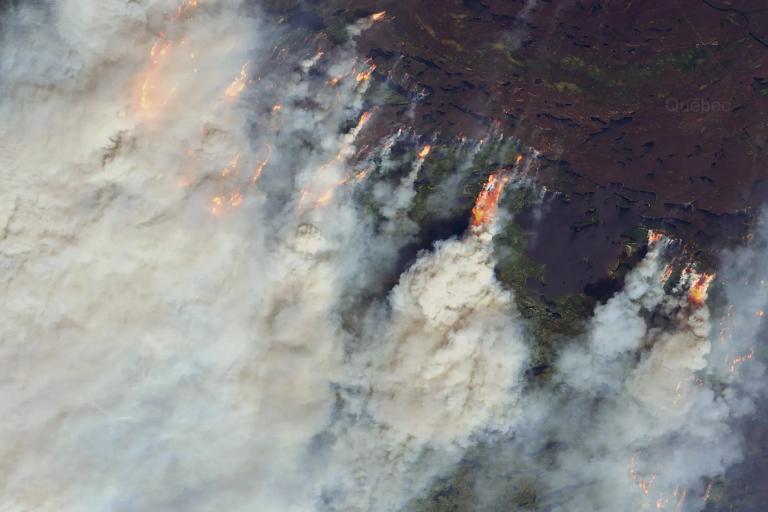
In June 2023, people across New York woke up to orange skies. Smoke from hundreds of wildfires burning in Canada had drifted south, shrouding cities across the northeastern United States and pushing air pollution to hazardous levels. Schools cancelled outdoor activities and millions were advised to stay indoors.
The smoke did not stop there. In the weeks that followed, it crossed the Atlantic and reached Europe, a reminder that the effects of major wildfires can extend far beyond the areas directly affected by flames.
The Canadian wildfires were not an isolated event. In 2024, more than 44.2 million acres of the Brazilian Amazon burned, an area larger than the state of California. Major fires in Australia and southern Europe have also produced smoke plumes that travelled across continents. Together, these events highlight the growing reach of wildfire smoke and its increasing influence on air quality, public health and atmospheric conditions.
Health impacts
According to the World Health Organization (WHO), air pollution contributes to 6.7 million premature deaths each year. Wildfire smoke contributes to this burden, as exposure can trigger asthma attacks, worsen chronic respiratory diseases and increase the risk of heart problems. Children, elderly people and those with pre-existing health conditions, are particularly vulnerable.
The primary pollutant of concern is fine particulate matter (PM2.5), which consists of particles with a diameter of 2.5 micrometres (μm) or less. These particles are small enough to penetrate deep into the lungs and enter the bloodstream. During extreme fire events, PM2.5 concentrations can reach levels 10 to 20 times higher than the WHO air quality guidelines.
In addition to direct emissions, wildfires can enhance chemical processes in the atmosphere, accelerating the formation of ground level ozone (O3), a harmful air pollutant. This secondary pollution often peaks far downwind from the flames, affecting populations across large regions. Wildfire smoke also frequently coincides with extreme heat events. Recent studies have shown that combined exposure to high temperatures and smoke can increase cardiorespiratory health risks and hospitalizations.
Early warning systems play a crucial role in reducing these health risks. By providing advance notice of smoke events, governments and communities can implement timely protective measures. Through the Early Warnings for All initiative, WMO is advancing these efforts by promoting standardized frameworks, enhancing interoperability and fostering international collaboration on fire weather services.
Understanding wildfire smoke
Three main factors influence wildfire occurrence and behaviour: an ignition event, weather conditions that favour fire development and fuel availability. Once ignited, a fire can spread and sustain itself if sufficient fuel is available. Terrain, including mountains and valleys, can significantly influence the rate of spread by pre-heating fuel and altering wind patterns. Under extreme conditions, the heat generated by a fire can create powerful rising air currents, causing the fire to spread in unpredictable ways.
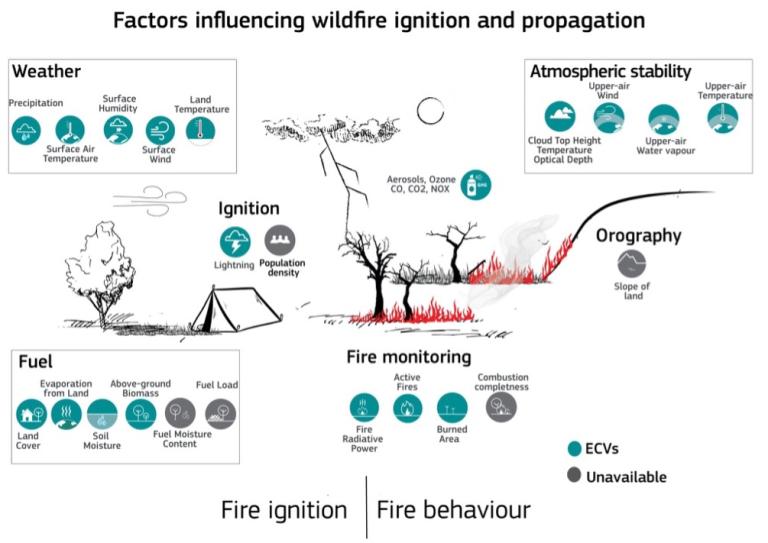
Wildfires release large quantities of smoke into the atmosphere. Smoke is a complex mixture of gases and suspended particles (aerosols) produced by the combustion of vegetation and other organic matter. Its composition varies with fuel type and burning conditions. Unlike industrial or other anthropogenic (human-related) emissions, which are often concentrated in urban or industrial areas and occur continuously, wildfire emissions can be highly episodic and variable. In some cases, wildfire smoke can be carried high into the upper troposphere and even the stratosphere through pyrocumulonimbus (pyrCb) clouds.
Warmer and drier conditions increase wildfire risk and extend fire seasons in many parts of the world. Wildfires release greenhouse gases such as carbon dioxide (CO₂), methane (CH₄) and nitrous oxide (N₂O), together with particles, reactive gases and other pollutants that affect air quality and atmospheric composition.
Although annual wildfire emissions of CO2 remain lower than those from fossil fuel combustion, they are still significant. Scientists are increasingly studying how more frequent and intense fires may affect ecosystems and the ability of forests and other natural systems to store carbon over time. Wildfires also emit black carbon, which can darken snow and ice surfaces, reduce their reflectivity and contribute to faster melting in sensitive cryosphere regions.
How smoke travels
Weather and climate play a major role in how wildfire smoke moves through the atmosphere. Factors such as temperature, air pressure, moisture and sunlight influence weather patterns and determine how air masses travel. Large climate patterns, such as the El Niño–Southern Oscillation (ENSO), can further alter regional temperatures, rainfall and wind circulation, affecting both wildfire activity and the spread of smoke. As a result, smoke from wildfires can travel thousands of kilometres from its source.
In Southeast Asia, seasonal biomass burning associated with land management and agricultural practices can generate persistent haze conditions. Similarly, biomass burning in the Amazon basin and sub-Saharan Africa can influence atmospheric composition and air quality over large areas, including downwind continental and oceanic regions. Recent events illustrate the scale of this transboundary phenomenon.
Addressing this challenge requires strengthened international cooperation, including coordinated monitoring, forecasting and information-sharing, as no single country can effectively manage its impacts in isolation.
Smoke in Southeast Asia
Southeast Asia experiences frequent smoke events driven by vegetation fires associated with agricultural burning, land clearing, and the drainage and burning of peatlands. Smoke from these events releases large amounts of air pollutants and can reduce visibility, disrupt aviation and tourism and have wider socio-economic impacts.
The seasonal pattern of haze is strongly influenced by the migration of the Intertropical Convergence Zone (ITCZ). From January to April, drier conditions in northern areas of the region favour increased fire activity, while from June to October burning tends to be more prevalent in southern areas. While the most severe impacts on air quality typically occur during El Niño conditions (e.g. 1997, 2015, 2019), elevated fire activity in non – El Niño years can still lead to widespread and persistent air quality degradation.
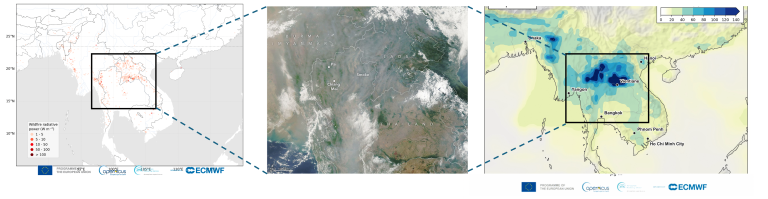
During the strong El Niño conditions of late 2023, persistent dry weather contributed to extensive burning, with smoke transported across maritime Southeast Asia and affecting air quality in Singapore and neighbouring areas. In March 2024, widespread seasonal fires in parts of Myanmar and northern Thailand led to severe haze conditions across the mountainous regions of mainland Southeast Asia, where atmospheric stagnation and topography favoured the accumulation of PM2.5 near the surface.
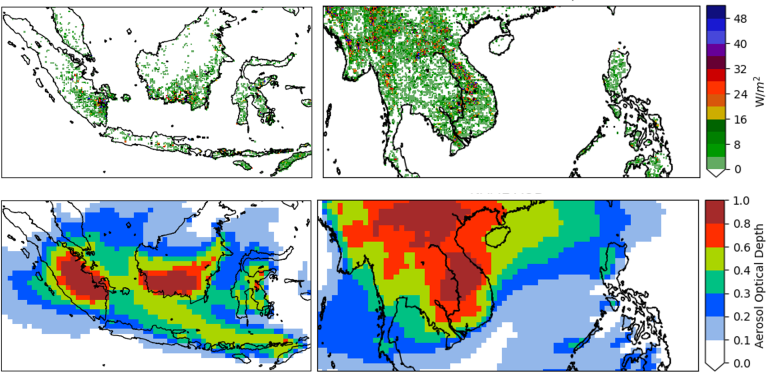
Similar conditions during the 2026 fire season again demonstrated how prolonged dry periods, elevated temperatures, and transboundary transport can rapidly intensify regional haze impacts.
From fire detection to smoke forecasting
Satellite and ground-based observations provide near-real-time information on active fires. These monitoring systems are complemented by fire weather products, including indicators of fuel dryness, wind conditions and temperature extremes, which help identify areas at high risk of fire. Atmospheric composition forecasting systems are then used to predict smoke dispersion and air quality impacts, providing information for public health advisories and emergency response planning. Together, these tools support early warning, preparedness and response.
However, monitoring the occurrence and evolution of fires represents only part of the challenge. Anticipating the transport and impacts of smoke requires advanced atmospheric modelling capabilities. Recent advances in Earth observation systems are further enhancing monitoring and forecasting capabilities. Products derived from global and geostationary satellite platforms and emerging atmospheric composition missions are improving the detection of active fires, burned areas, aerosol concentrations and smoke transport at higher temporal and spatial resolution. In parallel, research initiatives are integrating artificial intelligence, atmospheric chemistry and fire behaviour modelling to improve forecasts of fire occurrence, emissions and smoke dispersion.
In this context, WMO established the Vegetation Fire and Smoke Pollution Warning Advisory and Assessment System (VFSP-WAS) initiative under the Global Atmosphere Watch (GAW) Programme. The initiative provides global coordination and standardization on the integration of observations, meteorological and smoke pollution forecasting capabilities to provide timely warnings and assessments of fire danger and smoke dispersion, supporting decision-making for public health and environmental protection.
VFSP-WAS has specific regional activities that are coordinated by their associated regional centres. As of 2026, there are two regional nodes: the Southeast Asian node with a regional centre in Singapore, hosted by the Meteorological Singapore Service (MSS), and the North American node with a regional centre in Montreal, hosted by Environment and Climate Change Canada (ECCC). The Montreal and Singapore Regional Centers are also recognized as Regional Specialized Meteorological Centres (RSMCs) under the WMO Integrated Processing and Prediction System (WIPPS). They generate operational products and provide technical support to National Meteorological and Hydrological Services (NMHSs).
WMO also plays a key role in the Global Fire Management Hub (Fire Hub) by providing expertise in fire weather, atmospheric composition, smoke monitoring and forecasting, and multi-hazard early warning systems. Established by the Food and Agriculture Organisation (FAO) and the United Nations Environment Programme (UNEP), the Fire Hub aims to strengthen global capacities for Integrated Fire Management (IFM) and support a shift from reactive wildfire suppression to proactive prevention, preparedness, and resilience.
Remaining challenges
Annual climate outlooks indicate that fire seasons are becoming longer and more severe globally, with extreme wildfires projected to increase by 14% by 2030 and up to 50% by the end of the century. Despite major advances in wildfire monitoring and smoke forecasting, important challenges remain.
In several regions, particularly parts of Africa and South America, limited ground-based monitoring networks, constrained forecasting capacity, and uneven access to observational data continue to hinder the timely detection and assessment of wildfire smoke impacts. Differences in national air quality standards, fire reporting practices and data management systems can further complicate communication of risk across borders.
A further challenge is ensuring that smoke pollution and its health impacts are fully integrated into operational early warning systems. While fire detection and fire weather forecasting have advanced rapidly, smoke exposure remains less consistently incorporated into many warning frameworks, despite posing significant risks to public health. Recent assessments have also identified persistent gaps between scientific fire and smoke information and its practical application in decision-making, highlighting the need for more user-oriented and impact-based early warning systems.
Future priorities
Addressing these challenges will require stronger international coordination and sustained investment in observations, prediction systems, and operational services. Expanding monitoring coverage through both in-situ networks and satellite observations remains a priority, particularly in underserved regions.
A major scientific and operational frontier lies in improving wildfire prediction across timescales, from days to seasons. Sub-seasonal to seasonal (S2S) forecasting aims to bridge the gap between weather forecasts and seasonal climate outlooks by providing useful information two to six weeks in advance. Longer-term climate outlooks, including those produced through the WMO Global Annual to Decadal Climate Update, are also becoming increasingly important for understanding how climate variability and change may reshape future fire regimes. This additional lead time can support earlier preparedness measures, more strategic deployment of firefighting resources and improved anticipation of smoke-related health impacts.
The integration of smoke forecasting and air quality impacts into end-to-end wildfire early warning systems remains a key priority. This includes moving beyond fire occurrence and fire weather indicators to incorporate emissions estimation, plume rise, atmospheric transport and surface-level pollutant exposure. Strengthening data sharing and interoperability will be essential to ensure that fire and smoke information can be used consistently across regions and sectors.
Recent wildfire seasons have shown that smoke can affect communities far beyond the fire line. As such events become more frequent and severe in many parts of the world, improving our ability to anticipate and communicate smoke risks will be essential to protecting lives, livelihoods and ecosystems.