

Feux de forêt
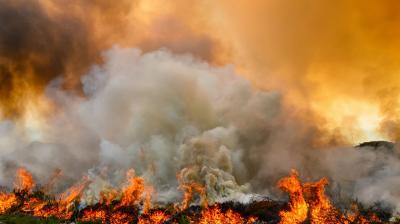
Les feux de forêt ont un impact croissant sur les populations, les écosystèmes et l'atmosphère à l'échelle mondiale. Provoqués par des facteurs météorologiques, climatiques et humains, ils mettent des vies en danger, détériorent la qualité de l'air en raison de la pollution par la fumée et contribuent aux effets du changement climatique.
Vue d'ensemble
Les feux de forêt sont des incendies incontrôlés qui se déclarent dans les forêts, les prairies, les zones arbustives et d'autres espaces naturels. Ils sont influencés par les conditions météorologiques, le climat, la végétation et les activités humaines. Bien que les incendies soient un processus écologique naturel dans de nombreux écosystèmes, l'augmentation de leur fréquence et de leur intensité a des effets dévastateurs sur les vies, les moyens de subsistance, la biodiversité, les infrastructures, la qualité de l’air et le climat. Selon un rapport du PNUE, l’augmentation des feux de forêt extrêmes pourrait atteindre 14 % d’ici à 2030 et 30 % d’ici à 2050. De plus, il ressort de décennies de données satellitaires capturées par les instruments de l’Observatoire de la Terre de la NASA que les feux d’espaces naturels nordiques deviennent beaucoup plus fréquents et étendus dans le Grand Nord, à mesure que la hausse des températures et la foudre touchent des latitudes plus élevées de l’Arctique.
Les impacts des feux de forêt s’étendent bien au-delà de la zone brûlée. Les incendies rejettent dans l'atmosphère de grandes quantités de particules et de gaz à l'état de traces, générant des panaches de fumée qui peuvent parcourir des centaines, voire des milliers de kilomètres au-delà des frontières nationales. Ces émissions détériorent la qualité de l'air, réduisent la visibilité et ont des répercussions sur les conditions météorologiques et la composition de l'atmosphère, exposant des populations situées loin des incendies à une pollution nocive.
Les progrès réalisés dans les domaines de l'observation de la Terre, de la prévision numérique du temps, de la modélisation de la composition atmosphérique et des systèmes intégrés d'évaluation des risques d'incendie ont considérablement amélioré la capacité de détecter les incendies en cours, de prévoir les conditions météorologiques propices aux incendies et d'anticiper la propagation de la fumée, ce qui permet de diffuser des alertes plus précoces et de prendre des décisions éclairées en fonction des risques.
Impact
Les feux de forêt touchent tous les continents habités et constituent désormais l'un des aléas naturels dont la fréquence augmente le plus rapidement au monde. Leurs impacts s’étendent bien au-delà de la zone brûlée.
Les feux de forêt mettent des vies en danger, détruisent des habitations et des infrastructures, perturbent les réseaux de transport et les systèmes énergétiques, et entraînent des pertes économiques considérables. Ils produisent également d'énormes quantités de fumée contenant des particules fines (PM2,5), des substances chimiques qui contribuent à la formation d'ozone troposphérique nocif et d'autres polluants. Lors d'incendies de grande ampleur, la concentration de particules fines peut atteindre 10 à 20 fois les limites normales, persister dans l'atmosphère pendant plusieurs jours, voire plusieurs semaines, se propager d'une région à l'autre et d'un continent à l'autre, et dépasser facilement, pour les populations situées sous le vent, les seuils de sécurité respiratoire fixés dans les lignes directrices mondiales de l'OMS sur la qualité de l’air ambiant.
L'exposition à la fumée des feux de forêt est associée à des maladies respiratoires et cardiovasculaires et représente un risque particulièrement élevé pour les populations vulnérables, notamment les enfants, les personnes âgées, les femmes enceintes et les personnes souffrant déjà de troubles respiratoires ou cardiovasculaires. Chaque année, plus de 100 000 décès prématurés sont attribués exclusivement aux particules fines issues de la fumée des feux de forêt. Le système de suivi de cette question, dont les données sont publiées par le réseau coparrainé qu'est le Lancet Countdown, a enregistré un pic de 154 000 décès pendant la période d'activité extrême des incendies. Les épisodes de fumée peuvent également mettre les systèmes de santé à rude épreuve, réduire la visibilité, perturber le trafic aérien et les transports, et nuire à l'agriculture, au tourisme et aux activités de plein air.
Les feux de forêt ont également de graves conséquences sur l'environnement. Ils peuvent endommager les forêts, les tourbières et la biodiversité, altérer les bassins versants, accentuer l'érosion des sols et contribuer aux inondations et aux glissements de terrain après les incendies. Il est à noter toutefois que le feu reste un processus écologique important dans de nombreux écosystèmes, favorisant la régénération et la biodiversité lorsqu'il survient naturellement.
Réponse de l'OMM
En faisant progresser les prévisions météorologiques relatives aux incendies, les prévisions concernant la fumée et les systèmes d'alerte précoce axés sur les impacts, l'OMM aide les pays à réduire les risques que représentent les feux de forêt pour les populations, les écosystèmes, les infrastructures et la santé publique.
Dans le cadre du Programme de la Veille de l'atmosphère globale (VAG), l'OMM coordonne le Système d’annonce et d’évaluation de la pollution par la fumée et les incendies de végétation (VFSP-WAS), un partenariat international qui fournit des observations, des prévisions et des évaluations coordonnées relatives aux incendies de végétation et à la pollution par la fumée. Le VFSP-WAS renforce la capacité des pays de communiquer en temps utile des informations sur les risques d'incendie, la dispersion de la fumée et les répercussions sur la qualité de l'air, contribuant ainsi à des alertes précoces plus efficaces et à une meilleure protection de la santé.
L'OMM est également un partenaire clé du Pôle mondial de gestion des incendies (GII). Ce pôle rassemble des organisations internationales, des instituts scientifiques et des organismes opérationnels afin d’améliorer les capacités nationales en matière de gestion intégrée des incendies via le partage des connaissances, le développement des capacités, l'évaluation des risques d'incendie, les alertes précoces et le soutien aux politiques stratégiques.
L'OMM a également mis en place une équipe spéciale pour les services météorologiques relatifs aux incendies, afin de promouvoir une approche coordonnée à l'échelle mondiale en matière de services d'alerte précoce concernant les feux de forêt et la fumée, à l'appui du développement de systèmes d'alerte précoce intégrés et multidangers dans le monde entier. Grâce à cette initiative, l'OMM intensifie la collaboration internationale, facilite l'accès aux données essentielles et aux produits de prévision, et renforce la résilience afin de réduire la vulnérabilité face aux feux de forêt et à la pollution due à la fumée.
Ensemble, ces activités apportent une contribution à l'Initiative «Alertes précoces pour tous» et intensifient la coopération internationale pour améliorer la gestion des risques liés aux feux de forêt, atténuer les effets de la fumée sur la santé et rendre les populations plus résilientes.