

Services for Aviation Newsletter Issue 1/2026 (June 2026)
Newsletter Issue 1/2026 (June 2026)
Jump to:
- Foreword by the co-vice-Chair of the WMO Standing Committee on Services for Aviation (SC-AVI)
- Expectations for the fourth session of the Services Commission (SERCOM-4)
- Important updates to WMO publications
- Discontinuation of WMO-No. 49 Volume II, Parts III and IV
- Highlights of the 2026 WMO/UKMO Aviation Meteorology Training Seminar
- AvRDP2 project closure and publication of the final report
- Advancing Volcanic Ash Science and Services: AG-VSA and WMO Contributions to ICAO’s IAVW Work Stream
- WMO Aviation Training Repository: Update
- News from the ICAO Secretariat
- News from the WMO Secretariat
- Upcoming WMO meetings and events
- Coming up next time
Foreword by the co-vice-Chair of the WMO Standing Committee on Services for Aviation (SC-AVI)

Dear colleagues,
It feels as though 2026 has only just begun, yet we are already almost halfway through. The last few months in particular have shown that the aviation industry must not only prepare for a changing climate but, alongside growth-related capacity issues, also remain responsive to a complex and evolving operating environment. Airspace disruptions, diverted routes, uncertainty around the availability of essential resources, changes in travel patterns, as well as an emerging El Niño event, all present additional challenges that require continued attention and coordination.
As noted in the last newsletter, the comprehensive restructuring of the WMO Secretariat remains underway. The appointment of the leadership position for the newly created Marine and Aviation Services (MAS) Section is understood to be nearing completion at the time of writing (more on this further down in the current newsletter). The SC-AVI would like to extend its sincere thanks to Stéphanie Wigniolle and Adriana Oskarsson who, despite ongoing resource constraints, continue to provide outstanding support to WMO’s aviation services and to SC-AVI in particular. At the same time, WMO's capacity to provide financial support for aviation-related work remains limited. As a result, events such as a further International Workshop on Volcanic Ash or another edition of the highly successful Aeronautical Meteorology Scientific Conference will need to be deferred to a later date. It is nevertheless hoped that WMO will be in a position to support at least one of these two events during the next intersessional period.
Since the last SC-AVI-4 meeting in November 2025, the team have reviewed and refined working priorities to best address resource constraints and organisational changes, which is reflected, among other things, in the updated work plans of the subsidiary bodies.
Recently, SC-AVI have been able to revise and update a number of guidelines and other reference materials to such an extent that they are now mature enough to be submitted to the higher-level WMO bodies for endorsement. You can read more about this in the section on the upcoming SERCOM-4 meeting and the forthcoming updated publications below. Furthermore, this latest issue of the newsletter features exciting information about an Aviation Meteorology Training Seminar organised jointly by WMO and the UK Met Office, the publication of the final report on the second phase of the Aviation Research and Development Project (AvRDP2), news on the Aviation Training Repository, updates from our colleagues at ICAO, and much more.
Enjoy reading and thank you very much for your continued commitment and support. Stay tuned!
Warm regards,
Kaspar Bucher-Studer
MeteoSwiss, Switzerland
Co-Vice-Chair of the WMO Standing Committee on Services for Aviation (SC-AVI)
Expectations for the fourth session of the Services Commission (SERCOM-4)
Submitted by Adriana Oskarsson, WMO Secretariat
The fourth session of the Commission for Weather, Climate, Hydrological, Marine and Related Environmental Services and Applications (SERCOM‑4) will be held at WMO Headquarters in Geneva, Switzerland, from 19 to 23 October 2026.
During the plenary sessions, the Commission is expected to consider, among other items, the report of the President of the Commission, reports from the chairs of SERCOM subsidiary bodies—including the Standing Committee on Services for Aviation (SC‑AVI)—as well as updated SERCOM subsidiary bodies Terms of Reference, revised working arrangements, and proposals for amending or updating WMO technical regulations and guidance. Strategic planning matters relevant to the Commission will also be addressed.
In this context, and taking into account recommendations from the fourth meeting of Standing Committee on Services for Aviation (SC‑AVI‑4), SERCOM‑4 will be invited to endorse several key updates. These include an update to Technical Regulations (WMO‑No. 49), Volume I to align with the ICAO Procedures for Air Navigation Services – Meteorology (PANS‑MET, Doc 10157), an update to the Guide to Meteorological Observing and Information Distribution Systems for Aviation Weather Services (WMO‑No. 731), and a revised Long‑term Plan for Aeronautical Meteorology (LTP‑AeM).
In addition, a new section for the Guide to Competency (WMO‑No. 1205), addressing personnel assessed as “not yet competent”, and a new competency framework for volcanic ash forecasters will be presented for information and approval, as necessary.
Additional details on SERCOM‑4 will be made available on the WMO Events and Meetings page in due course.
Important updates to WMO publications
Submitted by Adriana Oskarsson, WMO Secretariat, in coordination with Kaspar Bucher-Studer, Co-Vice-Chair of SC-AVI, and Kathy-Ann Caesar, Co-Chair of the SC-AVI Expert Team on Education, Training and Competency (ET-ETC)
Despite the recent WMO Secretariat reorganization and resource constraints, substantive progress has continued in maintaining and enhancing key technical regulations and guidance materials in aeronautical meteorology. This work is reflected in a series of publications that will be submitted to the fourth session of the Services Commission (SERCOM-4) for approval or presented for information.
A key development is the proposed amendment to the Technical Regulations (WMO-No. 49), Volume I. This amendment aims to establish a clearer alignment with the international standards, recommended practices, and procedures of the International Civil Aviation Organization (ICAO), specifically the Procedures for Air Navigation Services – Meteorology (PANS-MET) (Doc 10157). This update is particularly significant in light of the planned discontinuation of Technical Regulations (WMO-No. 49), Volume II: Meteorological Service for International Air Navigation by November 2027. The revised Volume I will be presented to SERCOM-4 for approval prior to submission to the 20th World Meteorological Congress (Cg-20) in 2027.
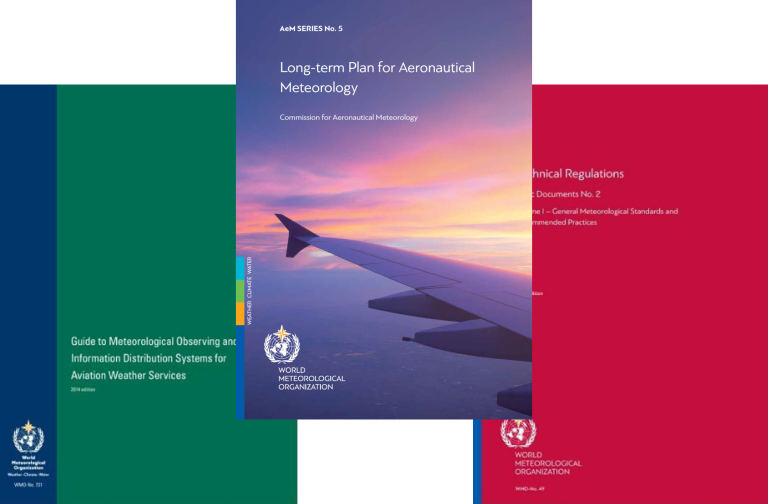
Progress has also been made on the updated Long-term Plan for Aeronautical Meteorology (AeM SERIES No. 5). As noted in the previous newsletter, the Standing Committee on Aviation (SC-AVI) approved the updated plan during its fourth session (SC-AVI-4) in November 2025. The plan, prepared by the Task Team on the Long-term Plan (TT-LTP), has since undergone a broad consultation process involving the Research Board and the Infrastructure Commission (INFCOM) Management Group, as well as the Services Commission (SERCOM) Management Group. This inclusive approach has ensured that the publication remains relevant and fit for purpose for WMO Members. The plan is scheduled for further consideration at SERCOM-4 later this year and then for presentation and promotion at the 20th World Meteorological Congress (Cg-20) in 2027. Following the dissolution of the Task Team, SC-AVI is now preparing supporting materials to facilitate the publication’s final adoption and to promote its dissemination. Updates will be shared via the Aviation Services Knowledge Hub.
In parallel, the SC-AVI Expert Team on Education, Training and Competency has completed a comprehensive review of the Guide to Meteorological Observing and Information Distribution Systems for Aeronautical Meteorological Services (WMO-No. 731) (new title). This guide provides an overview of observing systems that meet operational requirements and offers practical advice on selecting appropriate solutions for specific contexts. It also addresses data distribution, including an introduction to modern information exchange concepts and systems.
The updated guide is structured as follows:
- Chapter 2 addresses standard surface observations at aerodromes, focusing on key parameters such as surface wind, cloud base height, visibility, and runway visual range, while referring to other operational documents for detailed specifications.
- Chapter 3 examines additional remote-sensing systems, such as observational equipment tailored to aviation needs, highlighting its cost-effectiveness, particularly at high-traffic airports exposed to complex weather conditions such as convection.
- Chapter 4 describes data distribution mechanisms and systems, ensuring timely and reliable information flow.
- The final chapters cover archiving practices, quality control procedures, and monitoring requirements.
A new section has also been introduced in Chapter 4 to reflect the forthcoming implementation of System Wide Information Management (SWIM) and the ICAO Meteorological Information Exchange Model (IWXXM), marking an important step toward modernized data exchange standards. The revised edition of WMO-No. 731 is expected to be approved at SERCOM-4 in October and subsequently published in 2027.
In addition to these updates, SC-AVI has contributed new material to competency-related guidance. A draft section has been developed for inclusion in the Guide to Competency (WMO-No. 1205), providing practical guidance to National Meteorological and Hydrological Services on managing situations where operational personnel are assessed as “not yet competent.”
Moreover, a new competency framework for forecasters working at Volcanic Ash Advisory Centres (VAACs) has been developed. This framework is proposed for inclusion in the Compendium of WMO Competency Frameworks (WMO-No. 1209), further strengthening the global approach to specialized aviation meteorology competencies.
Together, these initiatives demonstrate WMO’s continued commitment to ensuring that its regulatory and guidance materials remain current, coherent, and aligned with evolving international standards and operational needs.
Discontinuation of WMO-No. 49 Volume II, Parts III and IV
Submitted by Andrea Henderson, Chair of SC-AVI
The discontinuation of the Technical Regulations (WMO‑No. 49), Volume II, Meteorological Service for International Air Navigation, continues to progress in accordance with the two-stage plan endorsed by the World Meteorological Congress (Resolution 12 (Cg‑19)). WMO-No. 49, Volume II, developed by WMO in partnership with ICAO, has historically provided internationally agreed provisions governing meteorological services for international air navigation.
The first stage has been completed. Parts I and II, which contained international Standards and Recommended Practices, were formally discontinued on 31 December 2023 [Refer 2023 newsletter article]. Responsibility for these provisions has transitioned fully to the International Civil Aviation Organization (ICAO), with ICAO Annex 3 now serving as the primary global reference for aeronautical meteorological standards. This change reflects the long‑standing alignment between WMO‑No. 49, Volume II and Annex 3 and removes unnecessary duplication arising from parallel publication and asynchronous amendment cycles.
The second stage, relating to Parts III (Aeronautical Climatology) and IV (Format and Preparation of Flight Documentation), is currently in progress. These parts are not being withdrawn immediately; instead, material of continuing relevance is being transposed into ICAO’s Procedures for Air Navigation Services - Meteorology (PANS‑MET, Doc 10157). This approach ensures continuity of essential technical guidance within a single ICAO framework.
A key milestone was reached with the publication of the first edition of PANS‑MET in 2025, applicable from 27 November 2025. Implementation is now in progress, with States aligning national practices and identifying differences. In parallel, ICAO is progressing amendments to PANS-MET to incorporate material of continuing relevance from WMO‑No. 49, Volume II Parts III and IV, with current planning indicating inclusion through Amendment 1, with intended applicability in 2027.
Overall, the discontinuation represents a strategic effort to improve efficiency, enhance consistency in international standards, and strengthening the delivery of aeronautical meteorological services worldwide, while maintaining the complementary roles of WMO and ICAO.
WMO continues to provide guidance and coordination to support Members through the transition, including the maintenance of a dedicated communications package outlining background, timelines and implications.
Highlights of the 2026 WMO/UKMO Aviation Meteorology Training Seminar
Submitted by Adriana Oskarsson, WMO Secretariat
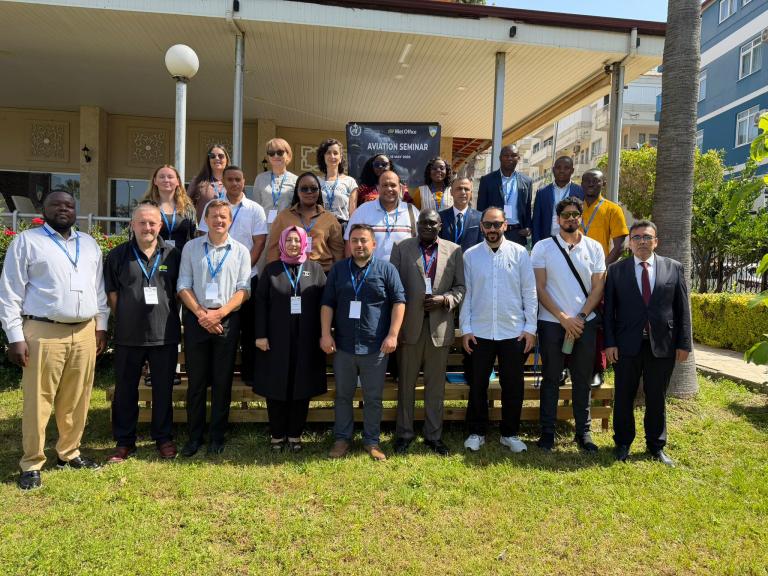
In May 2026, the United Kingdom Met Office (UKMO) in collaboration with WMO and the Turkish State Meteorological Service (TSMS) conducted a week-long Aviation Meteorology Training Seminar in Alanya, Türkiye.
Through a blend of theory and practical sessions, the 2026 training seminar covered a spectrum of aeronautical meteorology topics including the forecasting of severe convection, icing and turbulence, volcanic ash, the issuance of SIGMET information, and personnel competency assessment.
More than 100 nominations were received from 54 countries across WMO Regional Associations I (Africa), II (Asia) and VI (Europe), showing the clear demand for such a training. From these nominations, the organizing committee shortlisted 22 participants from 22 countries, of which more than one third are designated as least developing countries or small island developing States (LDC/SIDS) and around one third of participants were female. Most participants were aeronautical meteorological forecasters working at aerodrome meteorological offices and meteorological watch offices.
Making use of voluntary cooperation programme and other funds, WMO and the UK Met Office were able to provide financial support towards the travel and subsistence of many participants, especially those from LDC/SIDS countries.
The in-person training seminar was declared a great success, with participants giving it satisfaction score of 4.75 out of 5. A vast majority of participants were evidently very satisfied with the topics covered, the training resources provided, the mix of theoretical and practical sessions, and the group work activities that took place during the week.
WMO and the UK Met Office are now exploring the possibility to convene a similar in-person training seminar in 2027 or in 2028. Information will appear in the news section of the WMO Services for Aviation website if/when details of the next training seminar are confirmed and an announcement will be sent out to Permanent Representative in the target regions.
AvRDP2 project closure and publication of the final report
Submitted by Stéphanie Wigniolle, WMO Secretariat, in coordination with Hellen Msemo and Estelle de Coning, WWRP, WMO Secretariat
After four years of cutting-edge research and scientific developments, followed by a trial and experiment phase, the second phase of an Aviation Research and Development project (AvRDP2) of the World Weather Research Program (WWRP), led by the WMO Research Board with the support of SERCOM/SC-AVI came to its end on 31 December 2025. In January 2026, the AvRDP2 Scientific Steering Committee (SSC) with the support of experts and scientists from organizations involved in the project AvRDP2 consolidated the final report of the project, including a comprehensive set of outcomes and recommendations from the project.
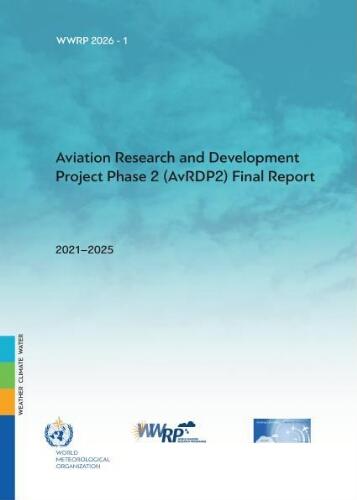
AvRDP2 aimed at demonstrating the benefits of a gate-to-gate use of advanced meteorological information for aviation operations, with a focus on scientific advancement in observation, and in deterministic and probabilistic nowcasting and forecasting of significant convection. Developments were performed over two air routes chosen by the SSC for the project, namely London to Johannesburg and Hong Kong to Singapore. Over the latter, some trials and experiments involving several categories of aviation operators were conducted over the last 15 months of the project, and feedback from these user groups was highly valuable, especially for the purposes of a verification and validation phase, both objective and subjective. The project explored options for the translation of meteorological data into actionable operational intelligence, such as making use of an impact-based metric, as well as the use of a statistical trajectory prediction system with convection avoidance as an example of an impact-based forecast information system. In addition to seamless-in-time blended deterministic and probabilistic forecast products, the project also considered the blending of two convection nowcast products for an end-to-end (seamless in space) nowcast prototype product for the long-haul route.
The final report of AvRDP2 includes a summary of the main results of developments and outcomes of trials over the two air routes, as well as a full report in annexes to the report. It also includes a section about a scientific research project supported by AvRDP2 and led by the Hong Kong University of Science and Technology (HKUST), which focused on predicting convection-induced turbulence (CIT). The research addressed topics such as how to predict CIT using convection-permitting simulations, probabilistic prediction of CIT using ensemble simulations and deep learning-based nowcasting using satellite imagery.
Moreover, a set of consolidated outcomes from the project and recommendations for WMO Members on research and scientific developments in observation and forecasting of significant convection were edited and included in the report. The linkage of AvRDP2 with the ICAO Hazardous Weather Information System (HWIS) and how outcomes and recommendations from AvRDP2 support this initiative from a science perspective are developed in the report. Methods and lessons learned from AvRDP2 could inform future initiatives to enhance aviation weather forecasting services globally, particularly by strengthening collaboration between the meteorological community and the aviation sector.
The final report was approved by the WWRP SSC, SERCOM/SC-AVI, SERCOM Management Group and the WMO Research Board in February 2026 and is now publicly available under the WMO e-Library as a WWRP SERIES 2026-1 document.
Further promotion of the AvRDP2 project, and outcomes and recommendations have been included into the April 2026 issuance of the MeteoWorld bulletin.
Advancing Volcanic Ash Science and Services: AG-VSA and WMO Contributions to ICAO’s IAVW Work Stream
Submitted by Matthew Hort, Co-chair of the WMO Advisory Group on Volcanic Science for Aviation Applications (AG-VSA)
The 32nd meeting of the ICAO Meteorology Panel’s Working Group on Meteorological Operations Group (WG-MOG) International Airways Volcano Watch (IAVW) Work Stream was held in Buenos Aires, Argentina, from 17–19 March 2026. The meeting brought together global experts to progress the scientific and operational framework underpinning volcanic ash services for aviation.
Presentations from the Volcanic Ash Advisory Centres (VAACs), industry and wider community members similarly focused on developments and how these can lead to real world operational improvements.
Members of the WMO Advisory Group on Volcanic Science for Aviation Applications (AG-VSA) played a central role in the meeting. AG-VSA co-chairs Dr. Matthew Hort (UK Met Office) and Dave Schneider (USGS) presented a comprehensive update on the group’s recent activities, including progress on eruption source parameter guidance, Quantitative Volcanic Ash (QVA) verification methodologies, and collaborative efforts with State Volcano Observatories (SVOs).
Recent years have seen the operational and research communities focused on the developments required for the rollout and adoption of QVA. QVA represents a significant change in the level of detail provided by the VAACs and for the first time includes the provision of probabilistic predictions. Following the first issuance of QVA by VAAC Toulouse for the Hayli Gubbi eruption (November 2025) the meeting considered lessons learnt by the VAACs and from the users (a rapid survey of airlines and air traffic management bodies having been conducted immediately after the event) in the ongoing QVA information improvements and harmonisation of practice.
Key outcomes included a formal decision to harmonize QVA data delivery across all nine Volcanic Ash Advisory Centres (VAACs), adopting common API and NetCDF standards, enhancing consistency and usability for end users globally. Noted and took actions, including AG-VSA, to continue to support SVOs in their important role and specifically in the provision of the Volcano Observatory Notice to Aviation (VONA). The meeting also advanced work on verification metrics for QVA forecasts, with AG-VSA supporting the development of robust performance indicators to assess forecast quality.
The meeting reaffirmed the value of international collaboration in addressing complex volcanic hazards. AG-VSA’s scientific leadership and coordination continue to be vital in bridging research and operations, supporting ICAO’s IAVW objectives, and enhancing global aviation safety.
Aviation Training Repository: Update
Submitted by Kathy-Ann Caesar, in collaboration with Harrison Burns, WMO Expert Team on Education, Training and Competency (ET-ETC)
The WMO Aviation Training Repository, mentioned in newsletter 2025/2, has recently seen further improvement, with additional tweaks enhancing navigation and overall usability. These refinements make it even easier for users to quickly locate relevant materials and move seamlessly through the platform.
We are also pleased to share that two new courses have been added:
These additions continue to expand the range of high quality training resources available to the aviation meteorology community.
As a reminder, the discussion forum remains the best place to ask questions, request resources, or provide feedback. It is actively monitored by the WMO Expert Team on Education, Training and Competency (ET ETC).
Your ongoing engagement helps ensure the repository continues to evolve and meet the needs of users worldwide.
Explore the repository here: https://aviationtraining.wmo.int/
News from the ICAO Secretariat
Submitted by Jun Ryuzaki, Technical Officer, Meteorology, ICAO
Turbulence - an Emerging Global Aviation Safety Risk
Did you know that the International Civil Aviation Organization (ICAO) publishes an annual Safety Report? The report provides a comprehensive overview of global aviation safety performance, emerging risks, and the initiatives undertaken to enhance aviation safety worldwide.
The latest 2025 Edition of the ICAO Safety Report is now available on the ICAO website. Despite global air traffic exceeding pre-pandemic levels, with more than 4.5 billion passengers carried in 2024, aviation safety remains a top priority for ICAO, its 193 Member States, and industry stakeholders. Although both the number of accidents and the global accident rate in 2024 increased compared with 2023, they remained below pre-pandemic era (2019) levels, reflecting the continued effort for the safety improvements under ICAO’s Global Aviation Safety Plan (GASP).
One area of growing concerns is turbulence. In 2024, turbulence-related events contributed to approximately 10% of fatal accidents and were associated with more than 72% of accidents involving serious injuries. Recognizing this trend, the Fourteenth Air Navigation Conference (AN-Conf/14), held in 2024, agreed to include turbulence encounters among global safety risk categories in the 2026–2028 GASP.
To respond to this challenge, ICAO - particularly through its Meteorology Panel (METP) - has initiated efforts to enhance meteorological services, focusing on improved turbulence forecasting and expanded turbulence data sharing in collaboration with industry partners and the World Meteorological Organization (WMO).
Technological advancements are also expected to strengthen turbulence awareness and mitigation. The global implementation of ADS-B Version 3.0 will support enhanced real-time exchange of turbulence information, while the World Area Forecast System (WAFS) is introducing higher-resolution forecasts and dedicated information for clear-air and mountain-wave turbulence. In parallel, ICAO is developing Hazardous Weather Information Services (HWIS), which will provide harmonized forecasts of turbulence and other en-route weather hazards through modern digital information services, to support safer and more efficient flight operations.

News from the WMO Secretariat
Submitted by Adriana Oskarsson, Marine and Aviation Services Section, WMO
The WMO Secretariat reorganization announced in the December 2025 issue of this newsletter (Issue 2/2025) took effect in January 2026.
As a result of the reorganization, the Standing Committee on Services for Aviation (SC‑AVI), together with the other Standing Committees, has undertaken a review of its working structure and Terms of Reference, including a prioritization of its activities and expected outputs. The updated Terms of Reference and revised working arrangements will be submitted for approval at the fourth session of the Services Commission (SERCOM‑4).
Under the new Secretariat structure, Services for Aviation has been integrated into a newly established Marine and Aviation Services Section. In this context, WMO is pleased to announce that Ms Justyna Wodziczko from the Norwegian Meteorological Institute will join the Secretariat as Chief of the new section in August 2026.
Ms Wodziczko brings extensive experience in aeronautical meteorology and marine meteorology alike. She previously served as Head of Division for Forecasting and, subsequently, Head of Aviation Weather Services at the Norwegian Meteorological Institute. She has also been actively engaged in WMO activities, most recently as Chair of the Advisory Group of the Worldwide Met‑Ocean Information and Warning Service Sub‑Committee under the SERCOM Standing Committee on Marine Meteorological and Oceanographic Services (SC‑MMO).
In her new role, Ms Wodziczko will lead the Marine and Aviation Services Section and oversee the delivery of Secretariat functions in aeronautical meteorology. She will be supported on aviation matters by Ms Stéphanie Wigniolle and Ms Adriana Oskarsson, working to support SC‑AVI and to respond to the evolving needs of WMO Members, aeronautical meteorological service providers, and partner organizations.
Upcoming WMO meetings and events
Note: All information given here is subject to change.
- Fourth Session of the Services Commission (SERCOM-4)), 19 to 23 October 2026, Geneva, Switzerland.
Coming up next time...
In the next issue of the newsletter readers can look forward to:
- Outcomes of EC-80 and SERCOM-4
- Expectations for EC-81 and Cg-20
...and more!
CLICK HERE to read previous newsletters
CLICK HERE to return to our homepage