

The 150th Anniversary of Meteorological Services in Japan - A 150-Year Journey: Preventing Disasters for a Better Future -
- News was produced by:
- Japan Meteorological Agency (JMA)
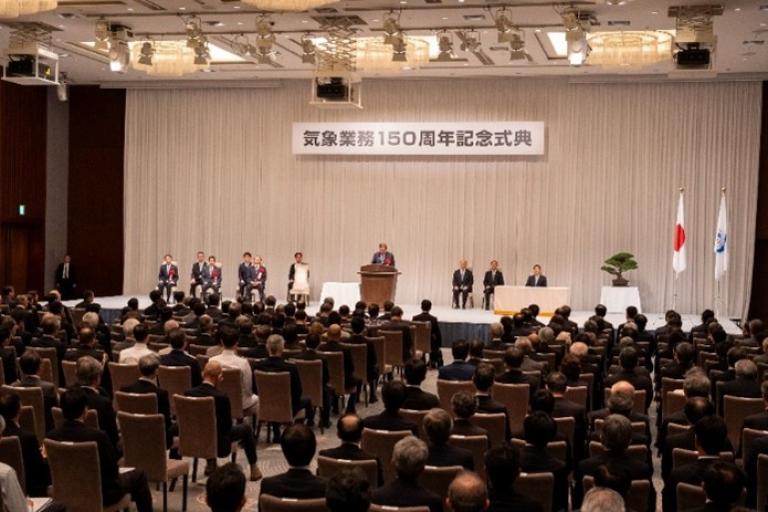
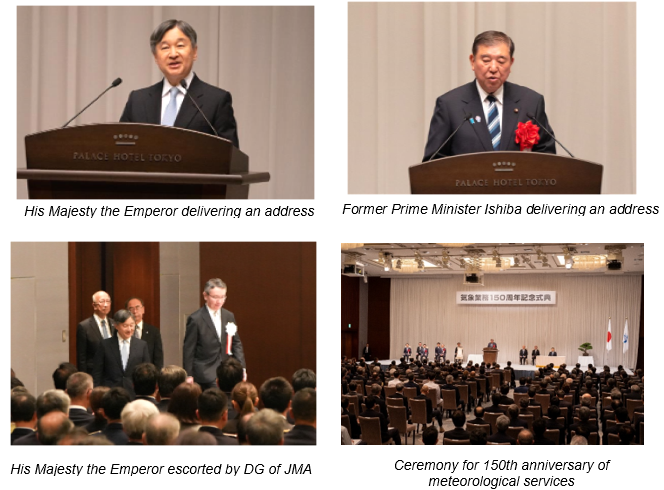
The year 2025 is the 150th anniversary of Japan’s meteorological services, which began on 1 June 1875. To mark the occasion, a commemorative ceremony was held on 2 June 2025 in the presence of His Majesty the Emperor and a number of high-level government officials, including former Prime Minister ISHIBA Shigeru and other distinguished guests involved in meteorological services in Japan.
Overview of JMA’s 150-Year Journey
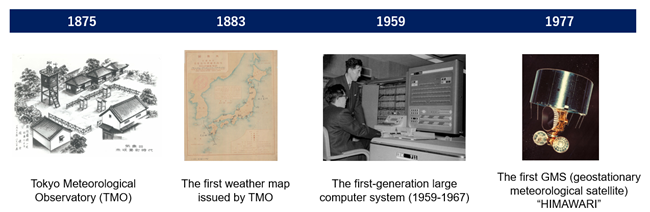
On 1 June 1875, the Tokyo Meteorological Observatory (now the Japan Meteorological Agency, or JMA), began observation using meteorological instruments and seismometers from Western countries. Since then, JMA has incorporated cutting-edge science and technology into its operational services, from observation to service delivery.
In 1883, it began issuing weather maps and storm warnings, followed the next year by the first weather forecast. To support this work, the country’s telegraph system (introduced in 1870) was used to quickly gather nationwide observation data. In the 1910s, wireless communication was introduced and used to transmit forecasts and warnings. In the 1930s, upper-air observation requiring wireless communication was fully implemented.
After World War II, the Meteorological Service Act, which established the legal foundation for meteorological services in Japan, was enacted in 1952. Japan joined the World Meteorological Organization (WMO) in 1953. While the global meteorological observation and forecasting systems were being developed under the World Weather Watch (WWW) programme, JMA proactively promoted the modernization of its meteorological systems through various initiatives, such as one called “National Weather Watch (NWW)”, by introducing state-of-the-art operational systems, including meteorological radar (1954 –), supercomputers and numerical models (1959 –), the Automated Meteorological Data Acquisition System (AMeDAS) (1974 –), and geostationary meteorological satellites (1977 –).
Furthermore, advances in Information Technology, and the proliferation of television, the Internet, mobile phones and social media have enabled JMA to introduce various operational systems for data processing and information dissemination to deliver timely information to a wide range of consumers.
Looking back on the 150 years of meteorological services in Japan, the progress we see today have been made not only with the advancement of science and technology but also through collaborative efforts with domestic and international partners, including bilateral cooperation with National Meteorological and Hydrological Services (NMHSs) of other countries and international organizations, especially cooperation through WMO is fundamental for JMA.
- WMO Member:
- Japan
- Region:
- Region II: Asia