
Global Seasonal Climate Update for January-February-March 2026
Observed Oceanic Drivers for the Previous Season
From September to November (SON) 2025, global sea‑surface temperatures (SSTs) were generally above average, except in the central and eastern equatorial Pacific.1 The extratropical North Pacific was particularly warm. In the equatorial Pacific, SSTs cooled slightly, with seasonal mean values consistent with a weak La Niña; however, an enhanced east–west SST gradient sustained coupled ocean–atmosphere signals more typical of a stronger La Niña, most clearly reflected in rainfall anomalies.
The Indian Ocean Dipole (IOD) remained in its negative phase, driven primarily by persistent above‑normal SSTs in the eastern Indian Ocean. In the Atlantic basin, SST anomalies were above average in the North Tropical Atlantic (NTA), while the South Tropical Atlantic (STA) remained near zero. Above‑normal SSTs also persisted across the extratropical North Atlantic.

Outlook for Oceanic Drivers for the Next Season
For January–March (JFM) 2026, cold SST anomalies in the central and eastern equatorial Pacific are forecast to weaken, indicating a gradual transition toward ENSO‑neutral conditions. Persistently above‑average SSTs in the western Pacific are expected to maintain a pronounced east–west gradient, reinforcing La Niña‑like atmospheric patterns across the equatorial Pacific.
The IOD index is also projected to weaken, moving toward near‑average conditions. In the equatorial Atlantic, SSTs in the northern tropics are expected to remain slightly above normal, while the southern tropics are forecast to stay near normal.
Surface Temperature Outlook for the Next Season
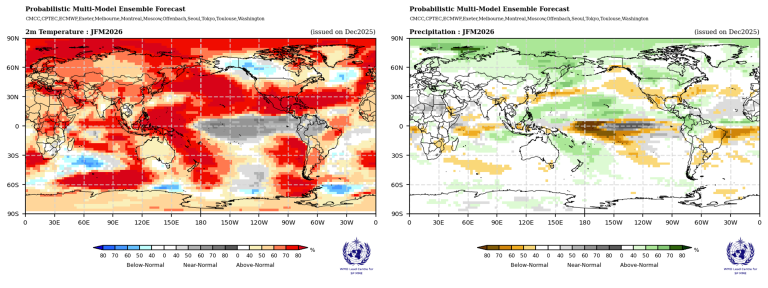
For JFM 2026, the multi‑model ensemble indicates a strong global signal for enhanced probabilities of above‑normal land surface temperatures, with high model agreement across much of the Northern Hemisphere north of 30°N (Fig. 4, top). Southern and northeastern North America, Central America, the Caribbean, and the Arctic all have elevated probabilities for above‑normal conditions, supported by robust model consistency. Areas lacking a consistent signal include northwestern North America, southeastern parts of the Indian subcontinent, and parts of Southeast Asia.
In the Southern Hemisphere, enhanced probabilities for above‑normal temperatures are predicted over northern New Zealand and southern South America along 30°S, while most of Australia shows only a weak tilt toward above‑normal conditions.
Across the tropics, strong enhancement in the probability of above‑normal temperatures is forecast over equatorial Africa and the Maritime Continent, with moderate to strong model agreement reinforcing this signal. A localized enhancement in probabilities for near‑normal temperatures appears over northwestern South America.
Over the oceans, widespread above‑normal temperatures are projected across the North Pacific, the Atlantic north of the equator between 10°–30°N, and the eastern Indian Ocean, with strong model agreement supporting these patterns. Elsewhere in the extratropical oceans, below‑normal conditions are limited to isolated regions of the Southern Ocean near 60°S. In the equatorial Pacific east of the Date Line, enhanced probabilities for near‑normal temperatures indicate a tendency to move toward ENSO‑neutral conditions.
Rainfall Outlook for the Next Season
For JFM 2026, rainfall predictions in the equatorial Pacific—amplified by an enhanced positive east–west sea‑surface temperature gradient—remain consistent with La Niña‑like conditions, even as SSTs are forecast to evolve toward ENSO‑neutral. Enhanced probabilities for below‑normal rainfall extend eastward from 170°E to near 160°W, where the signal bifurcates into northern and southern branches. The northern branch continues eastward toward the western coast of South America, while the southern branch arcs southeastward to near 120°W. Along the equator, probabilities for near‑normal rainfall are forecast from 160°W to the western coast of South America.
Overall, the JFM 2026 rainfall outlook reflects a La Niña‑influenced pattern, with suppressed rainfall across the central and eastern Pacific and enhanced rainfall over the western Pacific and adjacent land regions. Beyond the Pacific, enhanced probabilities for below‑normal rainfall are predicted over southern North America, parts of eastern Asia, northeastern South America extending into the southern equatorial Atlantic, and the western Indian Ocean. In contrast, probabilities for above‑normal rainfall increase over the Philippine Sea, northern North America, southern Central America extending into northwestern South America, the Caribbean, northern Europe, and northern Asia north of 50°N.
1 https://www.cpc.ncep.noaa.gov/products/attribution/images/Attribution202511.pdf