Strengthening Early Warning Communication Systems Across the Caribbean
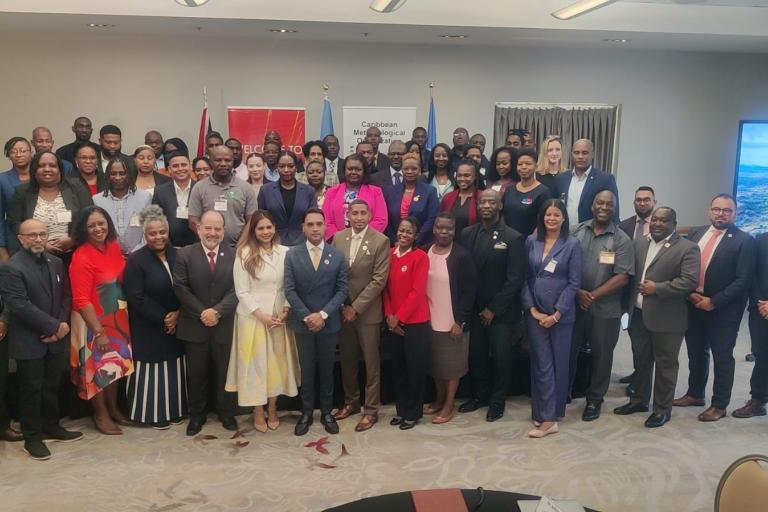
On 20 – 21 January 2026, the World Meteorological Organization, in partnership with the Caribbean Meteorological Organization (CMO) and the United Nations Office for Disaster Risk Reduction (UNDRR), convened a regional workshop in Port of Spain, Trinidad, to strengthen collaboration across the disaster risk communication chain.
The two-day “Regional Workshop on Strengthening Knowledge Exchange and Mutual Understanding between National Meteorological and Hydrometeorological Services (NMHSs), National Disaster Risk Management Offices (NDRMOs), and the Media” was executed under the Climate Risk and Early Warning Systems (CREWS) Caribbean Project Phase 2, co-led and implemented by WMO and UNDRR. The workshop brought together more than 60 participants from across the Caribbean, including senior representatives of meteorological services, disaster management agencies, government information services, and public and private media organizations.
The workshop aimed to strengthen coordination and communication of early warning information, ensuring that early warnings lead to early action, particularly for vulnerable and last-mile communities. This is being done in support of the global Early Warnings for All Initiative commitment to ensure that everyone, everywhere, is protected through multi-hazard warning systems.
The opening ceremony was attended by high-level national, regional and international representatives, including the Honourable Barry Padarath, Minister of Public Utilities and Minister in the Office of the Prime Minister of Trinidad and Tobago; the Honourable Clyde Elder, Minister in the Ministry of Public Utilities; Dr. Arlene Laing, Coordinating Director of the Caribbean Meteorological Organization; Mr. Rodney Martinez Guingla, Representative for North America, Central America and the Caribbean of WMO; Ms. Sonia Gill, Secretary General of the Caribbean Broadcasting Union; Mr. Anwar Baksh, Programme Officer with UNDRR; and Lt. Col. Kester Craig, Deputy Executive Director of the Caribbean Disaster Emergency Management Agency.
In his address, Mr. Rodney Martinez Guingla emphasized the critical role of communication for one of the most multi-hazard-prone regions in the world. “While scientific and technological capacity for hazard detection and forecasting has steadily improved, early warnings only save lives when they are effectively communicated, clearly understood, and acted upon. From WMO’s perspective, communication is not the final step of an early warning system—it is a core operational function.”
The workshop engaged participants in expert-led panels and presentations, case studies, and interactive group exercises focused on strengthening communication across the early warning value chain. Key issues addressed included:
- Improving the flow of information during emergency events
- Developing communication guidelines for prioritizing and scheduling messages
- Strengthening operational communication protocols
- Clarifying roles and responsibilities across institutions
- Identifying and reducing miscommunication and bottlenecks
Discussions examined institutional roles and responsibilities, human factors in decision-making, broadcast and publishing practices, and strategies for countering mis- and disinformation, while supporting the development of practical communication tools and message templates for use before, during, and after hazardous events.
Participants identified several priority actions to strengthen early warning communication across the Caribbean. These include improving the speed and consistency of information dissemination through coordinated, multi-channel communication; strengthening trust-based partnerships between meteorological services, disaster management agencies, and the media well before emergencies occur; and developing clear, ready-to-use messages and recommended actions that people can easily understand and act upon.
Emphasis was also placed on advancing impact-based forecasting, using simple and culturally appropriate language, and ensuring early warnings are designed to support early action, not only emergency response.
This workshop has set the foundation for more effective and coordinated weather, climate, and disaster risk communication across the region.
- WMO Member:
- Trinidad and Tobago