
What flood protection is worth in the Alps
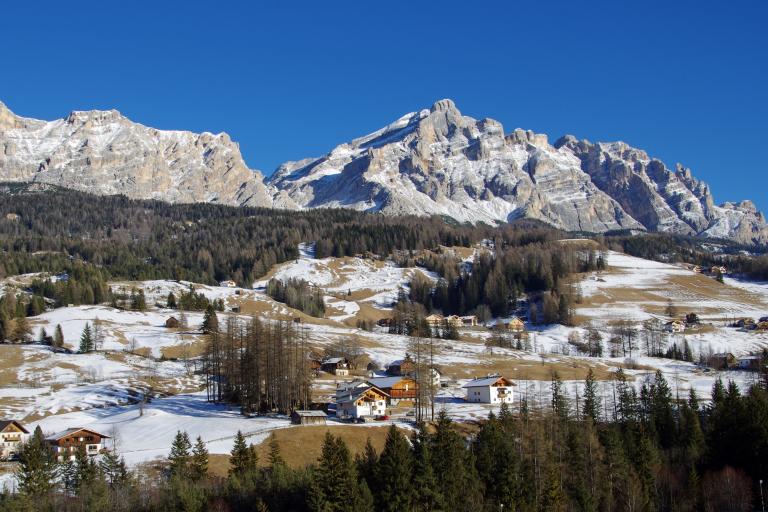
Flood and flash-flood risk in Alpine regions is increasingly affecting public safety and economic activity as the climate changes. Recent events in northeastern Italy have shown how quickly intense short-duration rainfall can disrupt communities and economies.
In Trentino-Alto Adige, such events can damage housing and productive land, interrupt transport corridors and essential services, and generate losses that extend beyond the immediate impact area through local supply chains and public budgets.
The region is one of the climate risk hotspots examined in the Cross-sectoral Framework for Socio-Economic Resilience to Climate Change and Extreme Events in Europe, 2024 – 2026 (CROSSEU), a Horizon Europe project that aims to strengthen resilience through cross-sectoral evidence and a stakeholder-designed decision support system. The project brings together meteorological services, universities, research institutes and international organizations, including the World Meteorological Organization.
The key question is how to prioritize adaptation investments as future flood exposure increases across multiple assets. For Trentino-Alto Adige, climate projections indicate substantial growth in the share of flooded areas across key land use categories and elevation zones by mid-century (2041 – 2050) and end-century (2090 – 2099).
In mountainous areas, for example, flooded surfaces are projected to reach 16% for residential areas, 15% for productive areas such as industrial and commercial zones, 21% for roads, 25% for agricultural land, and 16% for tourism infrastructure by 2090–2099. These projections are policy relevant because they point to significant impacts on housing and safety, increased pressure on agriculture and productive areas and potential constraints on mobility and service provision.
What residents value in flood protection
A key contribution of the CROSSEU approach is to complement projections of physical flood exposure with estimates of the value residents place on avoiding flood impacts. For public decision-making, this provides a clear measure of societal value that can help prioritize adaptation investments alongside engineering criteria.
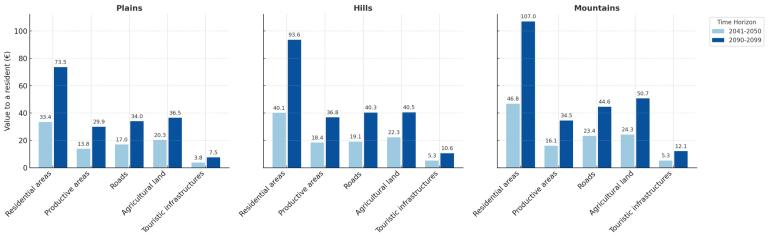
The findings show a consistent ranking of priorities for adaptation strategies (Figure 1). Protection of residential areas is valued most, followed by agricultural land and roads, then productive areas, while tourism-related infrastructure is valued least. This pattern suggests that perceived welfare losses are concentrated on housing and essential functions such as safety, access, and continuity of economic activity, rather than on sector-specific amenities.
From projections to investment decisions
When aggregated across the resident population of Trentino-Alto Adige, these valuations provide a benchmark for the total social benefits that could be achieved through effective flood mitigation and adaptation (Figure 2). The estimated benefits amount to approximately €63 million for 2041–2050 and €136 million for 2090–2099. In practical terms, these figures provide a benchmark for the scale of socially efficient investment. Adaptation measures whose costs exceed the estimated benefits are unlikely to deliver net welfare gains for residents, whereas those below these thresholds are broadly consistent with a positive net social return.
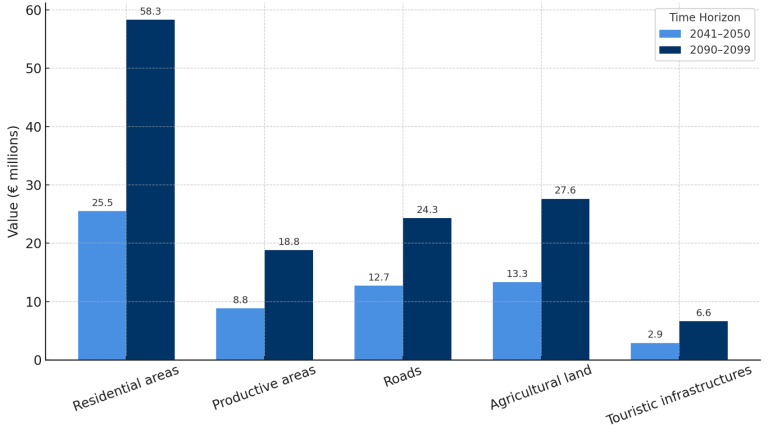
Expressing the benefits of climate risk reduction in monetary terms helps bring climate modelling results into public sector decision-making. This CROSSEU case study translates projected flood impacts into welfare-based estimates, producing both an asset-level ranking of what residents value most and aggregate benchmarks that can be compared with the costs of alternative adaptation packages.
This approach is transferable beyond the Trentino-Alto Adige, as many Alpine and pre-Alpine regions share similar characteristics, including steep topography, concentrated settlements in valley bottoms and increasing precipitation extremes.
- WMO Member:
- Italy
- Region:
- Region VI: Europe