
First CREWS SIEWAP Project Steering Committee Meeting and EW4All Peer Exchange

Share:
Icon
(Pacific/Apia: 09 March 2026, 09:00 - 16:00)
Past event
Icon

Samoa

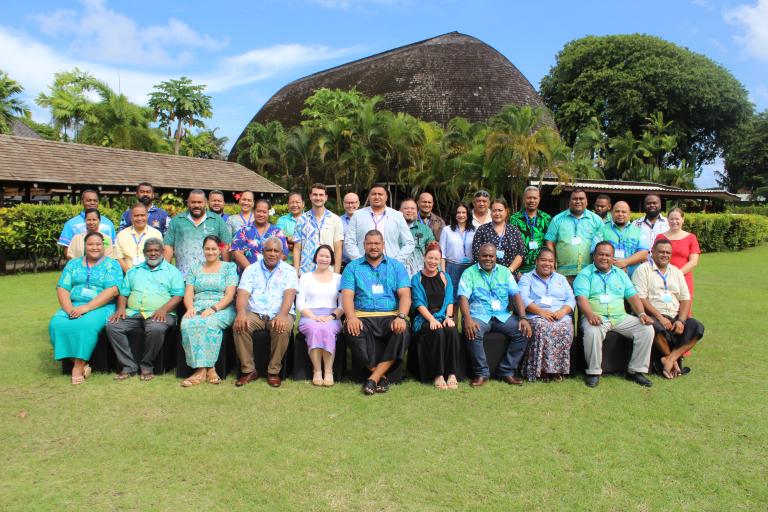
A large group of people pose for a photo outdoors in front of tropical greenery and a traditional wooden building under a blue sky.

The first project steering committee meeting was held for the Climate Risk and Early Warning Systems (CREWS) - Scale Up Inclusive Early Warning and Action in the Pacific (SIEWAP) Project on 9 March 2026 in Apia, Samoa to discuss, review and endorse the 2026 workplan of the project.

The CREWS SIEWAP project is a 4-year (2025-2029) regional CREWS Initiative-funded project in the Pacific whose primary objective is to scale up people-centred and end-to-end multi-hazard early warning systems (MHEWSs) across the Pacific.

The initiative covers Cook Islands, Federated States of Micronesia, Fiji, Kiribati, Republic of the Marshall Islands, Nauru, Niue, Palau, Samoa, Solomon Islands, Tokelau, Tonga, Tuvalu, and Vanuatu.

Click here for a snapshot of the project!

Alongside the CREWS SIEWAP Steering Committee meeting, there was an Early Warnings for All (EW4All) Peer Exchange discussion for countries to exchange experiences and lessons learned in the development of MHEWS roadmaps. The session brought together government representatives (NMHS and NDMO) and regional partners to discuss progress and challenges in the roadmap development process and explore opportunities for resource mobilization.

The meeting was participated by NMHSs and selected National Disaster Management Offices (NDMOs) of Pacific Members

Agenda

The EW4All Action Plan Peer Exchange Concept Note is available here: CREWS SIEWAP - EW4ALL Pacific Exchange March 2026.pdf

Time (LT)Agenda ItemPresentation(s)Speaker

1ST CREWS SIEWAP PEER STEERING COMMITTEE MEETING

Session 1 - Opening and Progress
08:30 - 09:00Registration -
09:00 - 10:00Formality Programme Mr Henry Taiki (WMO)
10:00 - 10:30Morning Tea and Group Photo
10:30 - 10:45

PSC ToR Endorsement and Selection of Chair and Vice-Chair

  • Endorsement of the PSC ToR and membership
  • Welcome remarks by Elected Chair

Objectives and Expectations of the PSC | Project Overview

Presentation: SIEWAP PSC

WMO/UNDRR

Elected Chair

10:45 - 11:00

Overview of WMO Restructure

Update on Project Progress/Challenges/Risks and Management

  • Project Progress
  • Risk Management
 WMO/UNDRR
11:00 - 11:30

Update on Project Finance/Delivery Rate

  • Delivery Rate 2025
  • Proposed Workplan and Budget 2026
  • Procurement Plan
  • Q&A Session (10min)

Project Reporting Timeframes and General Operations

 WMO/UNDRR
Session 2 - Opportunities and Collaboration
11:30 - 13:00

Share Alignments and Potential Opportunities

  • UNEP CIS-Pac5
  • WRP
  • Mobile Cell-Broadcast EWS Project (GSMA)

Presentation: UNEP CIS-Pac5

Presentation: WRP

WMO/UNDRR
13:00 - 14:00Lunch break
Session 3 - EW4All Peer Learning Sharing
14:00 - 14:15Welcome and Overview of the EW4All roadmap development process and regional process UNDRR/WMO
14:15 - 15:20

Pacific EW4All National Leads sharing of reflection based on the following guiding questions:

  • What is included in the roadmap and action plan?
    • Alignment with the four EW4All pillars (1 – disaster risk knowledge; 2 – detection, observation, monitoring, analysis, and forecasting; 3 – warning dissemination and communication; 4 - preparedness and response capabilities).
    • Multi-hazard and multi-sector integration (including hydrological and geophysical hazards and other environmental and possibly man-made hazards).
    • Governance arrangements and institutional roles (cross-cutting “Pillar 5”).
    • Costing, prioritization, financing strategies, funding sources, and sustainability aspects.
    • Inclusion of groups with specific vulnerabilities, including persons with disabilities.
    • Monitoring, evaluation, and reporting mechanisms, including potential updates to the roadmaps/action plans.
  • What has been the process?
    • Lead coordinating agency and cross-government engagement.
    • Identification of focal points for each Pillar.
    • National coordinators helping with coordination and drafting.
    • Gap assessments (both new ones specific to the EW4All process and leveraging existing ones).
    • Stakeholder consultations (national, subnational, community level).
    • Engagement with regional organizations, United Nations Resident Coordinator Offices and Country Teams, development partners, non-governmental organisations (NGOs), etc.
    • Integration of Anticipatory Action/co-development of early action protocols.
    • Political endorsement and integration into national development, disaster risk reduction, or climate (adaptation) plans/strategies.
  • What has worked?
    • High-level political leadership and clear mandates, national ownership.
    • Strong collaboration between NMHSs, NDMOs, National Telecommunication Regulators and Operators, and National Red Cross Societies, as well as the global EW4All Pillar Leads (UNDRR – Pillar 1, WMO – Pillar 2, International Telecommunication Union (ITU) – Pillar 3, International Federation of Red Cross and Red Crescent Societies (IFRC)) – Pillar 4) and their national and international partners.
    • Integration with existing national adaptation plans and disaster risk management frameworks and alignment with regional strategies and mechanisms, such as the Weather Ready Pacific (WRP) Programme.
    • Leveraging regional technical support and pooled procurement or services.
  • Gaps and learnings
    • Limited sustainable financing for technical infrastructure and maintenance.
    • Data-sharing constraints across agencies.
    • Capacity gaps at national, subnational, and community level.
    • Challenges in sustaining momentum and inclusive engagement and communicating the nature, benefits, and timeline of EW4All.
    • Lessons on sequencing, prioritization, and realistic timelines and budgets.
    • Use of the roadmaps/action plans by governments, national red cross societies, national partners, and especially international donors and regional organizations.
    • Support to countries starting to develop their national EW4All roadmaps/ MHEWS action plans while acknowledging their past and ongoing efforts in strengthening their MHEWS.

Presentation: Kiribati

Presentation: Tonga

Presentation: Solomon Islands

Fiji

Kiribati

Tonga

Samoa

Solomon Islands

*10 min per Country

15:20 - 15:30Open floor discussion/ Q&A All
15:30 - 15:45Afternoon Tea Break
15:45 - 16:00Summary/Wrap-up UNDRR/WMO

Document(s)

All meeting documents are available here: CREWS SIEWAP

Quick link

RA V Homepage

CREWS SIEWAP Webpage

Icon
For any queries, please contact: ttafua@wmo.int