Region I: Africa

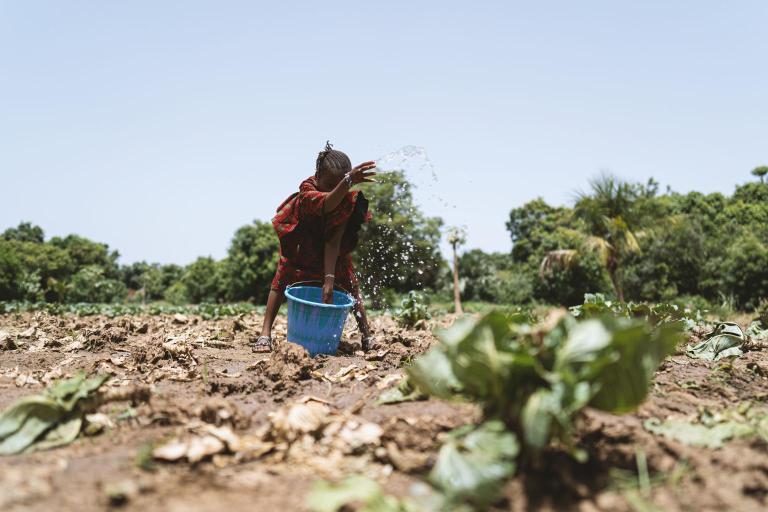
Africa is one of the world's most vulnerable regions to climate extremes, with 60% of the population not covered by any early warning systems. Africa is the second largest continent bounded by the Mediterranean and Red seas, the Indian and Atlantic Oceans, straddling both sides of the equator. It continues to face extreme weather events, floods, droughts, heatwaves, tropical cyclones and severe storms, heavy rains, and forest fires. 
Little African girl watering dry cabbage plants by hand under a cloudless blue sky.
Adobe Stock / Riccardo Niels Mayer
Africa's socio-economic landscape is diverse, marked by varying levels of development, economic activities, and social challenges, including extreme poverty rates, inequality, limited healthcare and education access, and political instability in some regions, and rapid urbanization, with potential for growth and innovation. Of significance, as of 2022, the United Nations designated 34 of the 46 globally recognized Least Developed Countries (LDCs) as located within the African continent.

The WMO Regional Office for Africa, headquartered in Addis Ababa, Ethiopia, works with National Meteorological and Hydrological Services (NMHSs) across 53 Members in the region, to strengthen data exchange, operational capacities in monitoring and forecasting and to develop early warnings systems. as well as regional institutions and development partners. 

Collaboration between the WMO Regional Office for Africa and regional institutions, development partners, key stakeholders including ECA, AICCRA, AfDB, AU, and various United Nations agencies, is essential for resource mobilization, knowledge enhancement, and expertise exchange. The WMO Regional Office for Africa recognizes the vital role played by NMHSs in safeguarding populations and enhancing socio-economic resilience to climate-related challenges. Through the reinforcement of climate service value chains, we are committed to enhancing early warning systems and facilitating the sustainable development of African communities. To ensure comprehensive coverage, our Regional Office maintains two Representative Offices: one situated in Abuja, Nigeria, serving 27 countries in North, Central, and West Africa, and the other located in Nairobi, Kenya, catering to the Eastern and Southern African region, encompassing 26 countries.


Projects in the region

Climate Risk and Early Warning Systems (CREWS) Artificial Intelligence (AI) for Early Warnings for All (EW4ALL) Malawi Project

The CREWS-funded Artificial Intelligence (AI) for Early Warnings for All (EW4ALL) Malawi Project, supported through a USD 245,775 single-donor award, aims to strengthen Malawi’s early warning capabilities by piloting the use of AI to enhance weather prediction and improve the timeliness and effectiveness of warnings. The initiative contributes to climate-resilient development by improving the systems and processes that enable anticipatory action and better preparedness for weather- and climate-related hazards. Through this investment, the project supports national efforts to enhance risk information, strengthen decision-making, and improve warning dissemination for communities vulnerable to climate shocks.As the Executing Agency, the World Meteorological Organization (WMO), through its services Department, oversees project implementation and ensures alignment with WMO technical cooperation standards. The project is implemented in partnership with the Department of Climate Change and Meteorological Services (DCCMS) in Malawi, along with technical engagement from Met Norway. WMO’s role includes financial administration, oversight, and the provision of technical support to strengthen forecasting, service delivery, and data-driven early warning capabilities. Through this support, WMO enables national institutions to actively participate in the climate services value chain, coordinate implementation partners, and enhance national capacity to operate improved early warning systems. By fostering collaboration between global, regional, and national experts, and ensuring strong financial and operational oversight, the project lays the foundation for a scalable and sustainable AI-enabled early warning framework for Malawi.

WMO Technical Advisory under AIM for Scale

Climate change is increasingly affecting agriculture across the globe, especially in low- and middle-income countries (LMICs), where smallholder farmers face growing uncertainty from erratic rainfall, rising temperatures, and extreme weather events. These challenges threaten food security, livelihoods, and national economies.To address these pressing issues, the Agriculture Innovation Mechanism for Scale (AIM for Scale) was launched as a bold initiative to bring evidence-based agricultural innovations to scale—starting with weather services.  WMO is involved in the AIM for Scale Programme Weather Package as a technical advisory partner supported by a grant from the International Affairs Office at the Presidential Court of the UAE. The initiative aims to scale climate services for farmers in countries across Africa, Asia, and South America. Current engagement includes Bangladesh, Chile, Ethiopia, Kenya, and Nigeria, with expansion to 30 countries planned by 2027.WMO supports the initiative through technical advisory on the following aspects: Country engagement through NMHSs and WMO Regional Training Centres, coordination to align the programme with WMO priorities and initiatives.,  the application of climate services in the agriculture sector through innovative co-production processes, enhanced capacity building and trainings for NMHSs and extension actors ; guiding in development of AI-focused weather and agrometeorology training with partners like the Mohamed bin Zayed University of Artificial Intelligence (MBZUAI), University of Chicago and WMO Members and regional centres.  As WMO Secretary-General Professor Celeste Saulo stated during COP29, " More and better data leads to better weather forecasts, early warning systems and climate information services for agriculture and other vital economic sectors. Closing basic data gaps will also help inform AI models.” Professor Saulo added that “the agriculture sector is undoubtedly one of the most vulnerable sectors to climate variability and change. Additional partnerships are needed to ensure that farmers are involved in the coproduction of weather and climate services which will enhance resilience and adaptation in the  agriculture sector.”  

Danish Support to EW4All

The four-year Denmark support to EW4All Project aims to enhance climate resilience and early warning systems in Niger, Somalia, South Sudan, Uganda, and Tanzania. With a grant of CHF 4.9 million from the Ministry of Foreign Affairs of Denmark, this initiative addresses recurring natural hazards, such as flash floods and droughts, that significantly impact these countries, causing loss of life and substantial economic and material damage.The Danish support project will facilitate immediate actions required to implement an integrated approach across the four pillars of EW4All: disaster risk knowledge; detection, observations, monitoring, analysis, and forecasting; warning dissemination and communication; and preparedness and response capabilities. It will also strengthen anticipatory action through the WMO Coordination Mechanism (WCM), support the design, delivery, and uptake of climate and risk information services, and assist in managing the global enabling environment of EW4All.The main activities of the project will involve the implementation of Multi-Hazard Early Warning Systems (MHEWS) in the five target countries. This includes the production, analysis, interpretation, and use of climate and risk information to strengthen MHEWS. The countries will also develop capacities to monitor and forecast priority hazards, generate and disseminate actionable early warning responses, and enhance community capacities to respond to, prevent, or mitigate the impacts of climate-related hazards. Furthermore, the project will foster an enabling policy environment to ensure effective coordination between relevant agencies and stakeholders in these countries.

Technical advice to reinforce national meteorological and hydrological services in Burkina Faso under HYDROMET project

Burkina Faso is a country facing climate risks. Its monsoon regime is associated with high temporal and spatial variability of rainfall. In recent years, extreme rainfall and severe flooding have devastated populations. Consequently, the country is preparing to consolidate warning services and reduce impacts on vulnerable communities. WMO has been supporting the Agence Nationale de la Météorologie (ANAM) and the Directorate Generale des Ressources en Eau (DGRE) to improve climate services through ClimSA and meteorological and hydrological services through CREWS Burkina Faso. Building on this, technical advisory support is being provided to the Government of Burkina Faso within the framework of the national GCF-financed HYDROMET project (P164078), funded by the World Bank.This technical assistance is aimed at supporting the modernization of meteorological infrastructures, and establishing a robust Early Warning System for floods (Sytèmes d’alerte précoce crues et inondations, SAPCI). In addition, cooperation between the main national institutions linked to warning systems is promoted and forecasting and warning operations processes are improved, prioritizing operational training. The support will build on the existing foundation, improve observation standards and their use in forecasting systems, foster cooperation between partners and projects to maximize technical support to national institutions, and increase operational training.

Strengthening Risk informed planning, Hydro-Meteorological and Early Warning Services in Malawi

The four-year Climate Risk and Early Warning Systems (CREWS) Malawi project – with a total contribution of US$3 million – aims to strengthen the production, delivery, and use of weather, hydrological, and early warning services to protect vulnerable communities and support risk-informed development. The project aims to enhance Malawi’s capacity to forecast floods, droughts, and other climate-related hazards, and to ensure that warnings reach those most at risk, including women, children, the elderly, and rural populations. The project supports sustainable development by improving preparedness, reducing disaster losses, and reinforcing climate resilience across agriculture, water resources, and urban and rural communities.The WMO-implemented component (US$1.46 million) supports Malawi’s national institutions – including DCCMS, the Department of Water Resources, and the Department of Disaster Management Affairs – to strengthen the climate and early warning services value chain through improved observations, modelling, data processing, community-centred dissemination, and last-mile communication. Underpinned by capacity development, gender and social inclusion, and user-driven co-production, WMO technical guidance addresses enhanced climate services (ENACTS), flood forecasting in the Shire Basin, drought monitoring, and the development of inclusive community-based early warning systems aligned with national and district-level policy processes. 

Supporting regional cooperation to strengthen seamless operational forecasting and multi hazard early warning systems at national level in the South-West Indian Ocean (CREWS SWIO)

The Climate Risk and Early Warning Systems (CREWS) South-West Indian Ocean (SWIO) project is a regional initiative involving Comoros, Madagascar, Mauritius, Seychelles, and Mozambique. The project supports these countries in strengthening their capacity to provide reliable, timely, and impact-based multi-hazard early warnings. By doing so, it contributes to protecting lives, property, and livelihoods from the increasing risks associated with extreme weather and climate events.With a total budget of USD 4 million, the project is jointly implemented by the World Meteorological Organization (WMO), the United Nations Office for Disaster Risk Reduction (UNDRR), and the World Bank. Of this, the WMO grant amounts to USD 1.75 million, aimed at supporting regional centers and national institutions in improving operational forecasting systems, strengthening coordination mechanisms, and enhancing service delivery both at national and regional levels.Given the SWIO region’s high vulnerability to climate variability and change, the project plays a crucial role in addressing risks related to tropical cyclones, storms, storm surges, floods, and other hydrometeorological hazards. The region’s exposure to such events, combined with limited adaptive capacity, underscores the need for stronger early warning and preparedness systems.To this end, the project promotes improved institutional coordination at the national level among hydrometeorological, disaster management, and sectoral agencies, while also enhancing regional collaboration among the five participating countries. This coordinated approach supports the development of seamless operational forecasts and the establishment of an integrated multi-hazard early warning system that serves as a foundation for climate resilience and risk-informed development.Recognizing the importance of sustaining these gains, a Phase II of the CREWS SWIO project is in the pipeline to continue addressing identified priority needs and to consolidate achievements at both regional and national levels 

Intra-ACP Climate Services and Related Applications (ClimSA)

The adverse impacts of climate change are a major challenge to the socio-economic development of developing countries, particularly the Least Developed Countries (LDCs), Small Island Developing States (SIDS) and Land-locked Developing Countries (LLDCs). The 79 Members of the Organization of African, Caribbean and Pacific States (OACPS) are considered to be the most vulnerable countries to the existential threats of climate change. Yet Member States of the OACPS have contributed least to greenhouse gas emissions.The Intra-ACP Climate Services and related Applications Programme (ClimSA) is a EUR 85 M initiative of the OACPS and the European Union. It is an important investment under the 11th European Development Fund (EDF) aiming to strengthen the climate services value chain: from access to information, generation and provision of climate services to engagement and capacity building of users to ensure utilization of these services.ClimSA aims to support the climate information services value chain with technical assistance, financial assistance, and infrastructure and capacity building support to improve wide access and use of climate information and applications for decision making processes at all levels, in the six regions of the OACPS through eight Regional Climate Centres (RCCs).As main users of climate services and the bridge to other final users, the African Regional Economic Communities (RECs), the African Union Commission (AUC), the Caribbean Meteorological Organization (CMO) and the Secretariat of the Pacific Regional Environment Programme (SPREP) will be the focus of the action to ensure sustainability and utilization of climate services. 

Climate Science Information for Climate Action (CSICA)

Since October 2018, and in response to the Paris Agreement (Article 7, paragraph 7 (c)) WMO and Green Climate Fund (GCF) have partnered to provide the global community with access to new climate information, tools, and guidance to facilitate the generation and use of climate information in support of climate action decisions, recognizing the contribution and value of science-based decision-making in responding to climate change.  Some of the products developed by WMO include a methodology for Developing the Climate Science Information for Climate Action (WMO-No. 1287), data, tools and associated technical resources for enhancing the climate science basis for GCF-funded projects and activities, as well as for National Adaptation Plans (NAPs) and climate policies.  The aim of providing these products is to help all countries, in particular least developed countries (LDCs), small island developing states (SIDS) and developing countries to identify and select the most effective climate actions to address climate impacts. In doing so, the guidance can contribute to country-level decision-making and the mobilization of climate finance.The Climate Science Information for Climate Action (CSICA) initiative was officially launched in 2021 at the twenty-sixth Conference of Parties (COP 26) to the United Nations Framework Convention on Climate Change (UNFCCC) in Glasgow, Scotland. Furthermore, the GCF Board at its thirty-third Session in July 2022 adopted Decision 19 (GCF B.33/19) recognizing the results of the WMO-GCF collaboration and acknowledged the importance of scaling up the support for strengthening the capacity of all stakeholders to access, synthesize, and incorporate relevant climate science information into climate action policies, plans and investments, as well as enhancing the hydrological and meteorological systems and associated climate information services for low-carbon and climate-resilient development.Noting significant demand from countries, and high-level political support for this work, WMO is implementing the CSICA initiative through the provision of institutional coordination support, technical advisory services, capacity development and increased partnerships. 

Full-Value chain Optimised Climate User-centric Services for Southern Africa (FOCUS-Africa)

FOCUS-Africa aims to deliver tailored climate services in the Southern African Development Community (SADC) region in four key sectors: agriculture and food security, water, energy, and infrastructure. The full-value chain of climate services will be demonstrated by piloting eight case studies in six countries involving a wide range of end-uses and beneficiaries. The case studies will illustrate how the use of climate science, forecasts and projections can maximize socio-economic benefits to specific national private and public sectors in the region. Pathways to scale-up the pilot cases are included for the whole Africa continent through the Regional Climate Fora.  The SADC countries are particularly vulnerable to climate variability, change and extremes: particularly water resources, agriculture, hydropower generation, ecosystems, and basic infrastructures are under stress as a result of increased frequency and intensity of floods, droughts and landslides. The development of improved climate information and forecasts of decision-relevant parameters are essential to address these challenges. Tailor forecasts such as rainfall onset and cessation are regularly requested by users, along with the associated skill information. Development and delivery of such products and services, and evaluation of socio-economic benefits are central to FOCUS-Africa. Both the science and the applications are targeted at specific requirements, capture through engagement with end-users through ongoing projects and consultations. Project end-users are either based, or have operations in Africa, and will therefore provide guidance on both the implementation and assessment of the case studies, and the ensuing delivery of the FOCUS-Africa climate services. Co-production between end users, climate scientists and sectoral service providers will also ensure effective delivery of climate services.  The project will not only benefit the SADC-based users, but the European consortium partners will also greatly enhance their knowledge in both the science and climate services provision. 

WMO Offices in the region

WMO Regional Office for Africa (RAF)

Lideta Sub City  

Yared Street 

Addis Ababa, Ethiopia 

New building (under construction): 
Bole 
Addis Ababa, Ethiopia 

Email: addis@wmo.int

WMO Representative Office for Eastern and Southern Africa (ESA) 

United Nations Complex, Gigiri 

Block P, Level 3, UN Avenue 

PO Box 1395-00606 

Nairobi, Kenya 

WMO Office in the Region for North, Central and West Africa (NCWA)

WING C, United Nations House 

Plot 617/618 Diplomatic Drive 

Central Area District PMB 2851 

Garki 

Abuja, Nigeria